South Korea Biomass Market
South Korea Biomass Market Size, Trends, Opportunity, and Forecast Analysis, 2026-2036
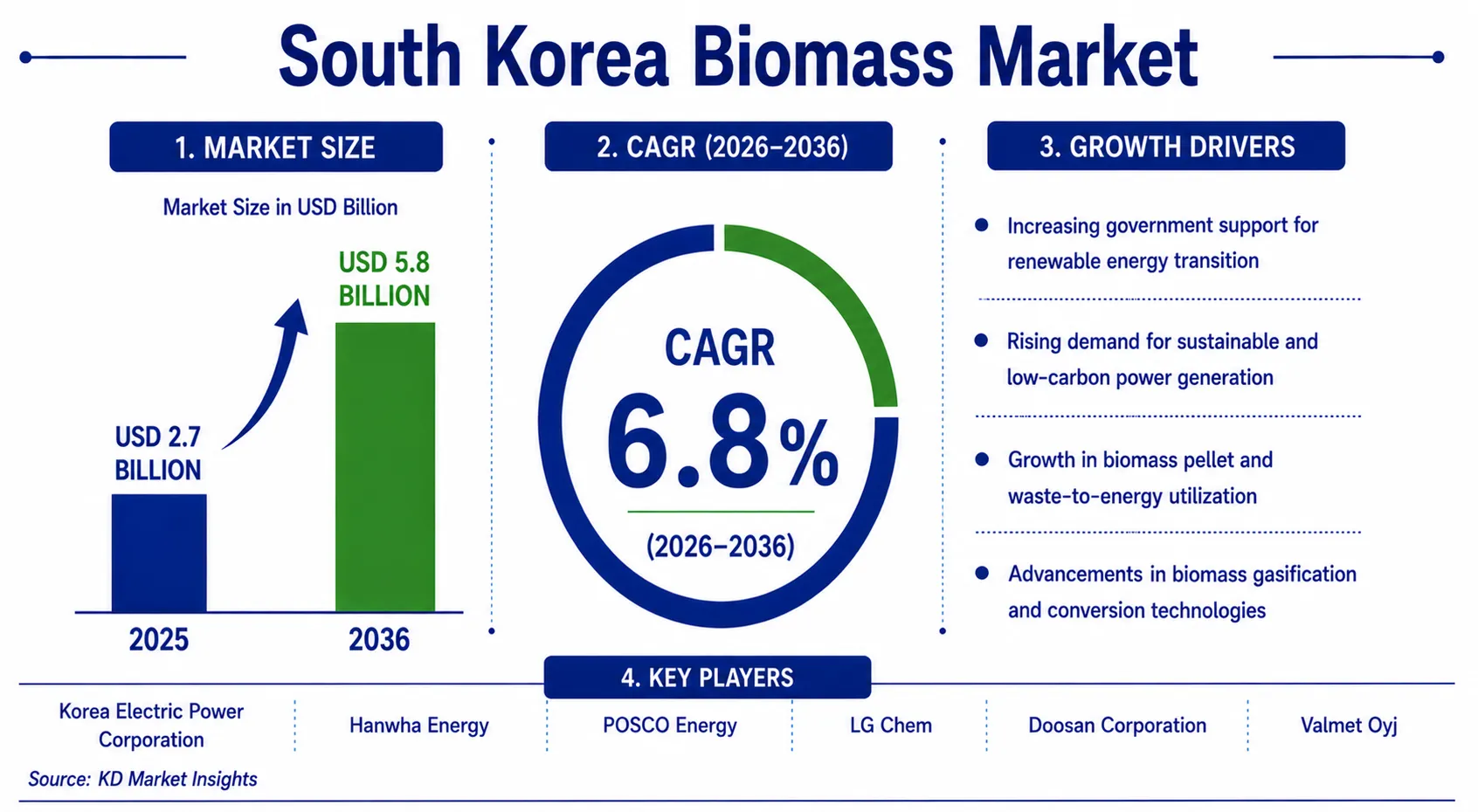
South Korea biomass market revenue to generate USD 5.8 billion by 2036, according to KDMI analyst’s growth analysis. The market is segmented by feedstock, technology, product, and end use.
Key Highlights
- 2025 Market Size: USD 2.7 Billion
- 2036 Forecast Market Size: USD 5.8 Billion
- CAGR (2026–2036): 6.8%
- Largest Segment: Wood biomass & power generation
- Fastest Growing: Agricultural residue, animal waste & gasification technologies
- Growth Drivers: Renewable energy policies, carbon neutrality goals, waste-to-energy adoption
- Key Players: Doosan Corporation, LG Chem, Hanwha Solutions, Hanwha Energy, POSCO Energy, Korea Electric Power Corporation, SK Eco Solution, Sungrow Power Supply.
What is the South Korea Biomass Market Size?
As per the survey report on South Korea biomass market, the market is expected to foresee a CAGR value of 6.8% during 2026-2036, and further generate a market size of USD 5.8 billion by the end of 2036. In 2025, the market size was value at USD 2.7 billion revenue.
- The South Korea biomass market’s growth is driven by carbon neutrality and decarbonization goals.
- KDMI analyst’s growth analysis foresees environmental concerns as restraint for South Korea biomass market.
- In the South Korea biomass market, wood pellets sub-segment under feedstock segment is playing significant role.
South Korea Biomass Market Analysis
Biomass is renewable organic material derived from living or recently deceased organisms, including plants, animals, and waste. It acts as a natural energy reservoir that stores solar energy through photosynthesis. Some common sources of biomass are wood, agricultural crops, forest waste, and animal manure, which can be converted into heat, electricity, and or biofuels. The South Korea biomass market is experiencing significant growth increasing awareness among people regarding renewable energy sources. The government has implemented certain initiatives to promote the use of biomass as sustainable energy alternative. As of 2022, the country is the seventh-largest energy-consuming nation, fulfilling its 97% of energy demand from overseas sources. The aim of reducing total energy consumption by 14.4% by 2030 and 18.6% by 2040 is further expanding adoption of renewable energy sources like biomass. This step is further accelerating adoption of biomass in power generation.
|
South Korea Biomass Market: Report Scope |
|
|
Base Year |
2025 |
|
Estimated Market Size |
USD 2.7 Billion in 2025 |
|
Forecast Year |
2025-2035 |
|
Projected Market Size |
USD 5.8 Billion in 2036 |
|
CAGR Value |
6.8% |
|
South Korea biomass Market Key Trends/ Growth Drivers |
|
|
Restraint Factors
|
|
|
South Korea biomass Market Segmentation |
|
|
South Korea biomass Market Key Players |
|
South Korea Biomass Market Growth Drivers and Restraints
Growth Drivers
- National carbon neutrality and decarbonization goals – South Korea’s goal of achieving carbon neutrality by 2050 is the key driver for biomass market. Korea’s Carbon Neutrality Act 2021 has set legal goals of controlling carbon emissions, making the country one of the first IEA Member countries to put stringent regulations in law. This framework supports adoption of biomass within the nation as a transitional and dispatchable renewable energy source that efficiently replaces coal in power generation. The Korean government had submitted Nationally Determined Contribution (NDC) and its Long-term Low Greenhouse Gas Emission Development Strategy (LEDS) to the United Nations on December 31, 2020. Moreover, biomass supports sectors that face challenge in power generation, such as industrial heating and waste management. This steps significantly aligns with climate change targets and regulatory mechanisms, thereby contributing to overall growth of South Korean market.
- Growing use of biomass feedstocks – The country is increasingly focusing on the development and utilization of domestic biomass resources to strengthen energy security and reduce reliance on imported wood pellets. As per the reports, the expansion of biomass in the country is driven by the Renewable Energy Portfolio Standard (RPS). Currently, the country relies heavily on approximately 3.9 million metric tons of wood pellets that are nearly 84.2% of all imports. Furthermore, policies are encouraging sustainable forest management and improved waste collection systems that helps to build a more reliable domestic supply chain. The significant shift toward renewable energy sources supports rural development by creating new revenue streams for farmers and local industries. Around 71% of South Korea’s wood pellets demand is fulfilled by imports from Southeast Asia. Much of the demand is met by Vietnam, as it is the second-largest wood pellet producers worldwide, thereby supporting biomass market growth.
Restraints
- High dependence on imported feedstocks – The key hurdle is that the country relies heavily on imported biomass feedstocks such as wood pellets. This leads the market to face global price fluctuations, foreign exchange risks, and supply chain disruptions caused due to geopolitical tensions. Also, transitioning from conventional energy sources requires higher upfront costs, which deter small-scale industries to adopt biomass as key product for power generation.
- Environmental concerns – Another key restraint is the use of biomass in power generation. Biomass produces more carbon emission than conventional sources and it leads to deforestation in the country. Therefore, regulatory decisions and growing sustainability concerns limit overall market adoption.
South Korea Biomass Market Segmentation
Our experts at KD Market Insights have segmented the South Korea biomass market research report as:
|
By Feedstock |
|
|
By Technology |
|
|
By Product |
|
|
By End Use |
|
Analyst’s Observation on South Korea Biomass Market Recent Developments
Over the years, the experts at KD Market Insights have been observing the recent developments associated with South Korea biomass market trends. Our expert’s market forecast analysis has recorded the market players adopting plentiful of key strategies including new product launches, mergers & acquisitions, and collaborations.
South Korea's Korea Forest Service is accepting first-round applications for its 2027 Wood Pellet Boiler and Heater Distribution Support Programme until 11 May. The scheme operates on a preemptive basis, with applications submitted the year before installation so that systems can be in place ahead of the winter heating season. Residential installations are eligible for a subsidy covering 70% of the product cost.
Korea Midland Power has unveiled a new biomass initiative in Boryeong, South Chungcheong Province, converting herbaceous waste from the Geumgang Estuary into eco-friendly fuel for power generation.
South Korea Biomass Market Competitive Landscape
Some of the significant participants who top the South Korea biomass market growth:
- Korea Hydro and Nuclear Power
- Korean Bioenergy Association
- Korea Research Institute of Bioscience and Biotechnology
- Hyundai Engineering
- Korea Electric Power Corporation
- Daewoo International
- LG Chem
- Samsung C and T
- GS Energy
- Socar
- SK E and S

Need Customized Report for Your Business ?
Utilize the Power of Customized Research Aligned with Your Business Goals
Request for Customized ReportRelated Reports
- Quick Contact -
- ISO Certified Logo -



Frequently Asked Questions(FAQ)
South Korea Biomass Market
-: Our Clients :-