US 800V Electric Vehicle Architecture Market
US 800V Electric Vehicle Architecture Market Size, Trends, Opportunity, and Forecast Analysis, 2026-2036
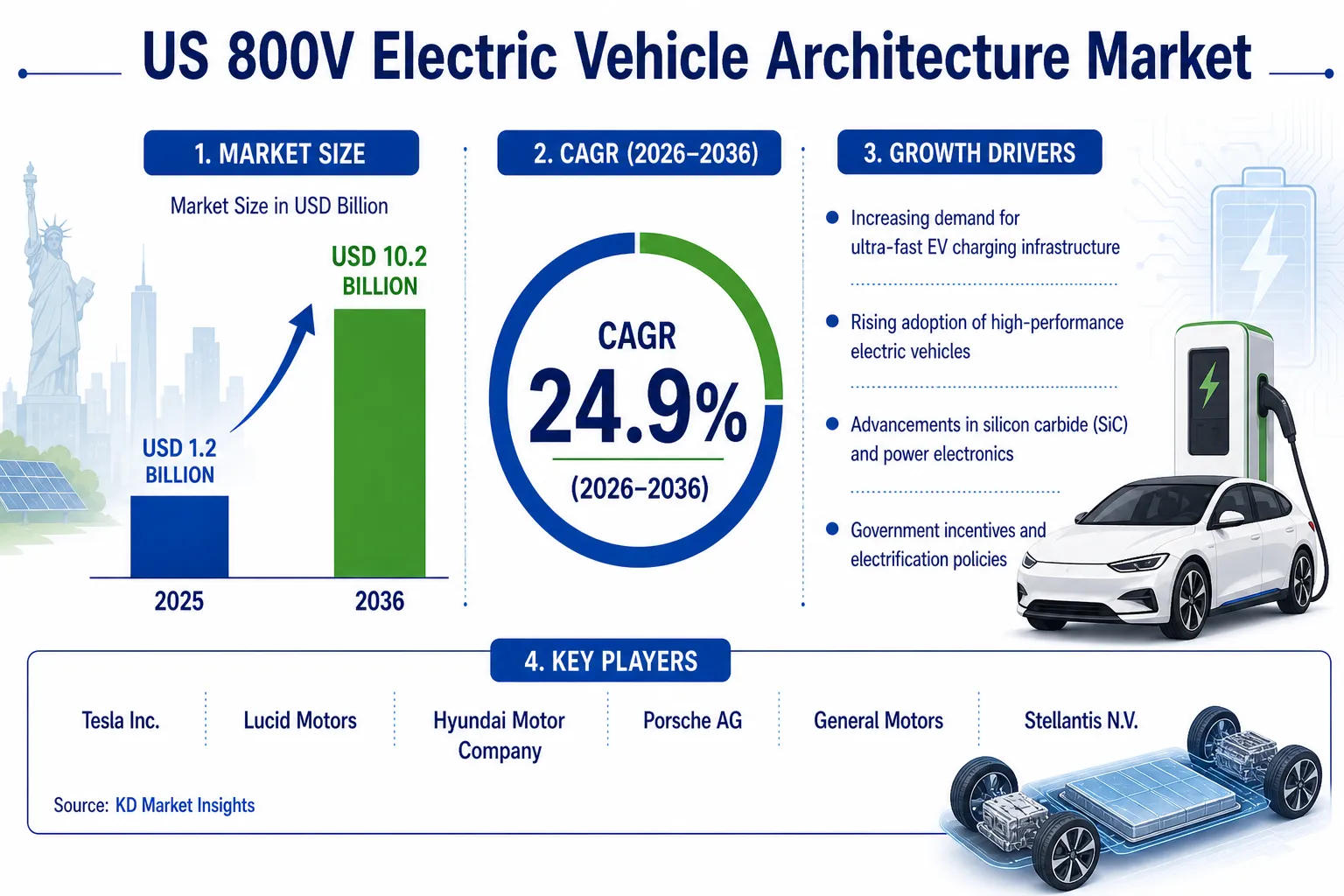
US 800V electric vehicle architecture market revenue to generate USD 10.2 billion by 2036, according to KDMI analyst’s growth analysis. The market is segmented by propulsion type, vehicle, component, end user, and end user.
Key Highlights
- 2025 Market Size: USD 1.2 Billion
- 2036 Forecast Market Size: USD 10.2 Billion
- CAGR (2026–2036): 24.9%
- Largest Market: Passenger electric vehicles (EVs) dominate the market which accounted for 72% market share.
- Fastest Growing Region: Commercial EVs (trucks, buses, fleets) are the fastest-growing segment.
- Key Market Drivers: Fast charging, EV adoption, tech advancements.
- Key Players: Tesla, General Motors, Lucid Motors, Stellantis, Hyundai Motor Company, BMW, Audi, Porsche, Proterra.
What is the US 800V Electric Vehicle Architecture Market Size?
As per the survey report on US 800V electric vehicle architecture market, the market is expected to foresee a CAGR value of 24.9% during 2026-2036, and further generate a market size of USD 10.2 billion by the end of 2036. In 2025, the market size was value at USD 1.2 billion revenue.
- The US 800V electric vehicle architecture market’s growth is driven by rising demand for ultra-fast charging.
- KDMI analyst’s growth analysis foresees supply chain constraints as restraint for US 800V electric vehicle architecture market.
What is 800V Electric Vehicle Architecture?
An 800V electric vehicle (EV) architecture is a high-voltage powertrain system that operates at a nominal voltage of 800 volts, enabling faster charging and greater efficiency compared to traditional 400V systems. By doubling the voltage, this system allows lower current for the same power, reducing heat, enabling lighter wiring, and increasing driving range. The United States 800V electric vehicle architecture market is driven by rising consumer demand for EVs with ultra-fast DC charging capabilities, along with extended driving ranges, and enhanced energy efficiency. According to the U.S Department of Energy, between 2015-2020, the number of EV charging ports has doubled. In 2021, the number of EV charging ports grew by more than 55%. Moreover, Federal initiatives like National Electric Vehicle Infrastructure (NEVI) Program is further creating opportunities for new entrants and investors, thereby supporting overall market growth.
|
US 800V Electric Vehicle Architecture Market: Report Scope |
|
|
Base Year |
2025 |
|
Estimated Market Size |
USD 1.2 billion in 2025 |
|
Forecast Year |
2025-2035 |
|
Projected Market Size |
USD 10.2 billion in 2036 |
|
CAGR Value |
24.9% |
|
US 800V electric vehicle architecture Market Key Trends/ Growth Drivers |
|
|
Restraint Factors
|
|
|
US 800V electric vehicle architecture Market Segmentation |
|
|
US 800V electric vehicle architecture Market Key Players |
|
US 800V Electric Vehicle Architecture Market Growth Drivers and Restraints
Growth Drivers
- Rising demand for ultra-fast charging – The growing consumer expectation for convenience comparable to internal combustion engine vehicles is a major force driving the shift toward 800V EV architectures in the United States. According to the reports, traditional 400V systems often required 30-60 minutes to achieve a substantial charge. While, 800V systems require only 15-20 minutes to achieve substantial charge. This improvements in charging capacities are necessary, especially for long distance travel and intercity commuting. Moreover, 800V systems can further improve overall energy efficiency by reducing electrical losses and allowing thinner, lighter cabling, which contributes to enhanced vehicle range and performance. A data report shows, nearly 204,000 non-home chargers were deployed in 2024 across the United States. As the United States consumers are increasingly prioritizing faster charging and longer driving ranges, automakers are effortlessly leveraging 800V architectures as a key differentiator, thereby supporting overall market demand.
- Strong government support and EV electrification policies – Another key factor supporting market growth is the government initiatives across the US are playing a pivotal role in accelerating the adoption of advanced EV technologies, including 800V architectures. Federal programs such as those supported by the U.S. Department of Energy and funding provisions under the Infrastructure Investment and Jobs Act are allocating billions of dollars toward EV infrastructure development, battery innovation, and domestic manufacturing. These government support and incentives further encourage institutions and organizations to increase investment in developing EV charging architectures. Moreover, stringent emission regulations are pushing automakers to adopt more efficient and future-ready EV architectures. These regulatory and financial measures accelerates EV adoption and encourages OEMs to invest in next-generation technologies like 800V systems to meet evolving policy and market requirements.
Restraints
- High cost of 800V components and system integration – One of the key challenges is the high costs associated with the components and raw materials required for 800V systems, including silicon carbide semiconductors, advanced insulation materials, and high-voltage wiring. These components can increase overall costs compared to traditional 400V systems, thereby limiting market potential.
- Supply chain constraints – The production of key components such as silicon carbide (SiC) substrates involves complex manufacturing processes and limited supplier availability. This creates major hurdles in the supply chain, affecting production scalability, increasing overall cost, and delaying widespread deployment.
US 800V Electric Vehicle Architecture Market Segmentation
Our experts at KD Market Insights have segmented the US 800V electric vehicle architecture market research report as:
|
By Propulsion Type |
|
|
By Vehicle |
|
|
By Component |
|
|
By Charging |
|
|
By End User |
|
Analyst’s Observation on US 800V Electric Vehicle Architecture Market Recent Developments
Over the years, the experts at KD Market Insights have been observing the recent developments associated with US 800V electric vehicle architecture market trends. Our expert’s market forecast analysis has recorded the market players adopting plentiful of key strategies including new product launches, mergers & acquisitions, and collaborations.
US-based automotive systems supplier BorgWarner has secured a programme award from a European original equipment manufacturer (OEM) to supply an 800V integrated drive module (iDM) for a range extended electric vehicle (REEV). BorgWarner stated that combining two major REEV functions into a single product supports vehicle architecture efficiency.
Intelligent power management company Eaton today announced the delivery of a new reference architecture designed to accelerate the adoption of 800 VDC power in artificial intelligence (AI) data centers. Eaton’s new design, built in support of the 800 VDC architecture announced by NVIDIA, leverages Eaton’s innovative power management technology to protect and optimize high-density computing infrastructure.
US 800V Electric Vehicle Architecture Market Competitive Landscape
Some of the significant participants who top the US 800V Electric Vehicle Architecture Market growth:
- Audi
- BMW
- General Motors
- Hyundai Motor
- Porsche
- Stellantis
- Tesla
- Thomas Built Buses
- Proterra
- Bollinger Motors
- Epiroc
- Komatsu
- Proterra (Volvo)
- Sandvik Mining and Rock Solutions
- Xos Trucks
- Lucid Motors
- Polestar
- Scout Motors
- BorgWarner
- EPC (Efficient Power Conversion)
- Navitas Semiconductor

Need Customized Report for Your Business ?
Utilize the Power of Customized Research Aligned with Your Business Goals
Request for Customized Report- Quick Contact -
- ISO Certified Logo -



Frequently Asked Questions(FAQ)
US 800V Electric Vehicle Architecture Market
-: Our Clients :-