South Korea Real Estate Market
South Korea Real Estate Market Size, Trends, Opportunity, and Forecast Analysis, 2026-2036
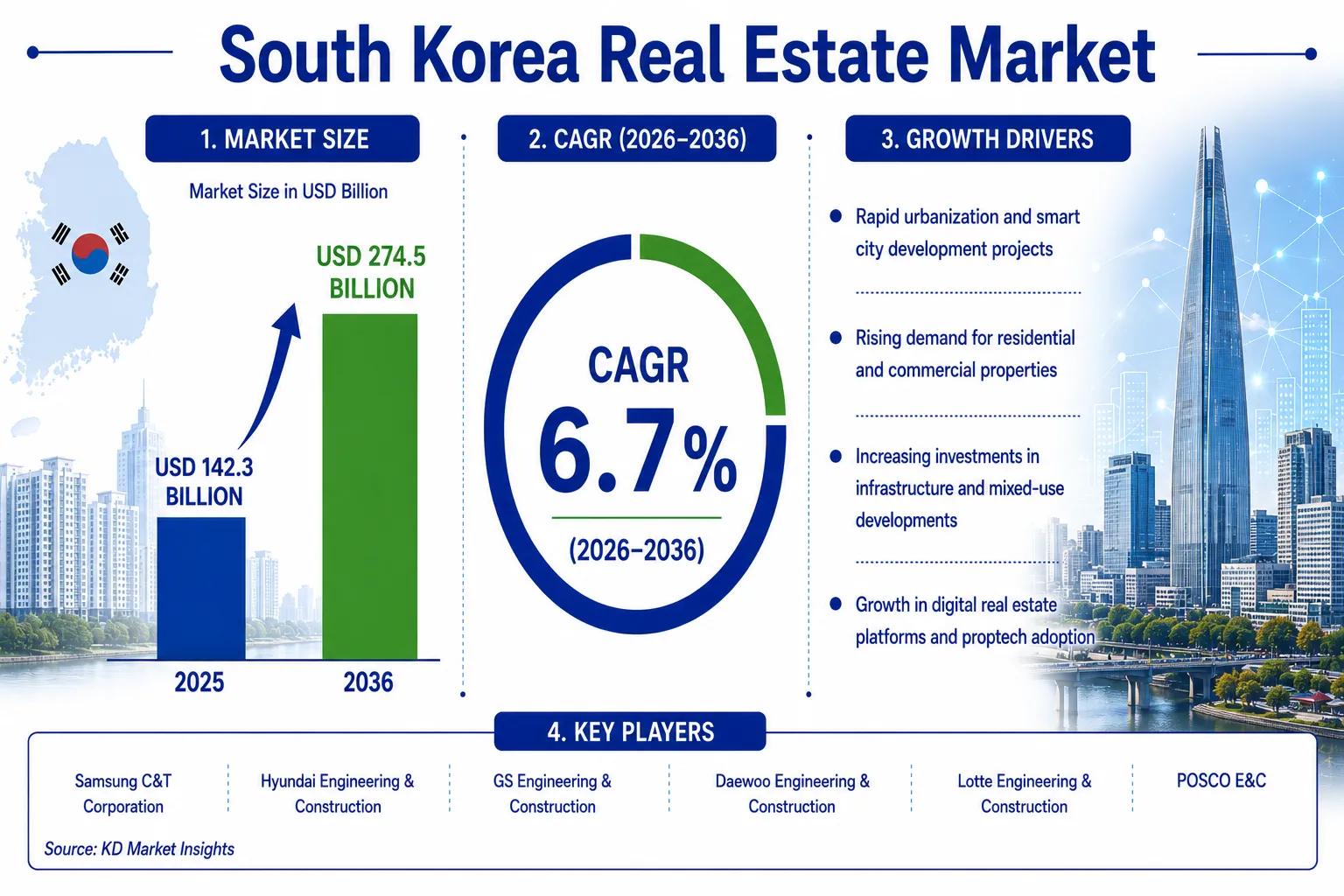
South Korea real estate market revenue to generate USD 274.5 billion by 2036, according to KDMI analyst’s growth analysis. The market is segmented by property and business.
Key Highlights
- 2025 Market Size: USD 142.3 Billion
- 2036 Forecast Market Size: USD 274.5 Billion
- CAGR (2026–2036): 6.7%
- Largest Segment: Seoul
- Fastest Growing: Residential & luxury rental properties
- Growth Drivers: Urban redevelopment, smart-city projects, REIT expansion, green buildings
- Key Players: Samsung C&T Corporation, GS Engineering & Construction, Hyundai Development Company (HDC), Lotte Engineering & Construction, POSCO E&C, DL Construction, CBRE Group, Cushman & Wakefield, Jones Lang LaSalle (JLL), and RE/MAX Korea.
What is the South Korea Real Estate Market Size?
As per the survey report on South Korea real estate market, the market is expected to foresee a CAGR value of 6.7% during 2026-2036, and further generate a market size of USD 274.5 billion by the end of 2036. In 2025, the market size was value at USD 142.3 billion revenue.
- The South Korea real estate market’s growth is driven by strong urbanization and housing demand.
- KDMI analyst’s growth analysis foresees land scarcity as restraint for South Korea real estate market.
- In the South Korea real estate market, residential segment is playing significant role.
South Korea Real Estate Market Analysis
Real estate is a term defined for a land or any permanent, man-made, or natural improvements attached to architectures such as buildings, houses, trees, or mineral rights. It represents a tangible asset and a key economic sector, primarily categorized into residential, commercial, industrial, and vacant land, which can be bought, sold, or leased. The South Korea real estate market is driven by more individuals migrate to urban centers in search of better employment opportunities and lifestyles, the demand for housing is surging. Additionally, the integration of smart technology in new constructions is becoming a priority, attracting tech-savvy buyers and renters. According to the 2010 Population and Housing Census report, 54.2% of housing stocks were occupied by owners and 61.3% of households owned at least one house. Moreover, environmental concerns and sustainability are gaining traction in the country’s real estate market.
|
South Korea Real Estate Market: Report Scope |
|
|
Base Year |
2025 |
|
Estimated Market Size |
USD 142.3 billion in 2025 |
|
Forecast Year |
2025-2035 |
|
Projected Market Size |
USD 274.5 billion in 2036 |
|
CAGR Value |
6.7% |
|
South Korea real estate Market Key Trends/ Growth Drivers |
|
|
Restraint Factors
|
|
|
South Korea real estate Market Segmentation |
|
|
South Korea real estate Market Key Players |
|
South Korea Real Estate Market Growth Drivers and Restraints
Growth Drivers
- Strong urbanization and housing demand – The South Korea market is experiencing significant growth due to rapid urbanization and growing housing demand. As of 2024, the share of urban population was amounted to 81.5%. The country has become highly urbanized with only 11% of population living in rural regions. Major metropolitan regions in the country are Seoul, Busan, and Incheon. These urbanized regions create significant employment opportunities, education institutions, healthcare facilities, and advanced infrastructure, thereby attracting large population to migrate in urban regions. Moreover, more than 20% of South Koreans living in rented houses, owns house outside the country. This structural concentration supports sustained demand for real estate sector growth in the country.
- Growth of commercial and industrial real estate – Seoul’s commercial real estate sector dominates South Korea’s market growth. With Seoul and Bundang office investment reaching 26.1 trillion KRW, up by 62% from 2020. Therefore, the rise of high-tech industries such as semiconductors, electronics, and e-commerce has further increased demand for office spaces, data centers, logistics hubs, and smart warehouses. Moreover, Industrial real estate is also contributing significant share in country’s real estate market by continuously benefitting from investments in manufacturing facilities and export-oriented production units.
- Government efforts and initiatives – The Korean government plays a vital role in the real estate market by implementing policies aimed at balancing supply and demand. Regulatory authorities have introduced multiple housing supply expansion plans, including new residential zones, public housing projects, and redevelopment initiatives in urban areas. In recent years, the South Korean government has announced its comprehensive measure to revitalize the indirect investment in real estate sector, aimed to expand public offering for more than ten times in the country. These coordinated policy measures are crucial in addressing key challenges, thereby supporting long-term market growth.
Restraints
- Land scarcity and supply constraints – One of the key challenges is the limited availability of developed land in metropolitan regions like Seoul, which restricts staring of new construction. Stringent environmental regulations and supply chain disruptions further restrict market expansion putting pressure of prices.
- High interest rates – Another major hurdle is the rising mortgage rates and stricter lending conditions that have reduced overall affordability. High mortgage rates discourage new home purchase, leading to higher loan costs and limited access to financing options. This limits growth potential of market, especially for first-time buyers in the nation.
South Korea Real Estate Market Segmentation
Our experts at KD Market Insights have segmented the South Korea real estate market research report as:
|
By property |
|
|
By business |
|
Analyst’s Observation on South Korea Real Estate Market Recent Developments
Over the years, the experts at KD Market Insights have been observing the recent developments associated with South Korea real estate market trends. Our expert’s market forecast analysis has recorded the market players adopting plentiful of key strategies including new product launches, mergers & acquisitions, and collaborations.
Nuveen has partnered with rental accommodation specialist Weave Living to acquire a building in central Seoul for redevelopment into a 62-unit serviced apartment project, marking the US investment manager’s debut living sector acquisition in the South Korean capital. This acquisition will create new opportunities for institutional-quality, purpose-built living product.
eXp Realty has announced its official entry into South Korea, its fifth international launch of 2025, and second in Asia this year after Japan. The expansion builds on rapid agent-led momentum across Peru, Türkiye, Ecuador, and Japan.
South Korea Real Estate Market Competitive Landscape
Some of the significant participants who top the South Korea real estate market growth:
- HOMETOWN REALTY
- Knight Frank
- CBRE
- Jones Lang LaSalle IP, Inc.
- Dentons Lee
- Samsung C&T Corporation
- HYUNDAI E&C
- LOTTE ENGINEERING & CONSTRUCTION
- HYOSUNG
- DONGBU CORPORATION
- Daelim Co., Ltd.
- BOOYOUNG GROUP
- BY KOREA LAND & HOUSING CORPORATION
- Hines
- ESR KendallSquare REIT Co., Ltd.
- DongWon Development Co., Ltd.
- GS E&C Corp.
- E-Starc Co., Ltd.

Need Customized Report for Your Business ?
Utilize the Power of Customized Research Aligned with Your Business Goals
Request for Customized Report- Quick Contact -
- ISO Certified Logo -



Frequently Asked Questions(FAQ)
South Korea Real Estate Market
-: Our Clients :-