Canada Immersive Technology in Healthcare Market
Canada Immersive Technology in Healthcare Market Size, Trends, Opportunity, and Forecast Analysis, 2026-2036
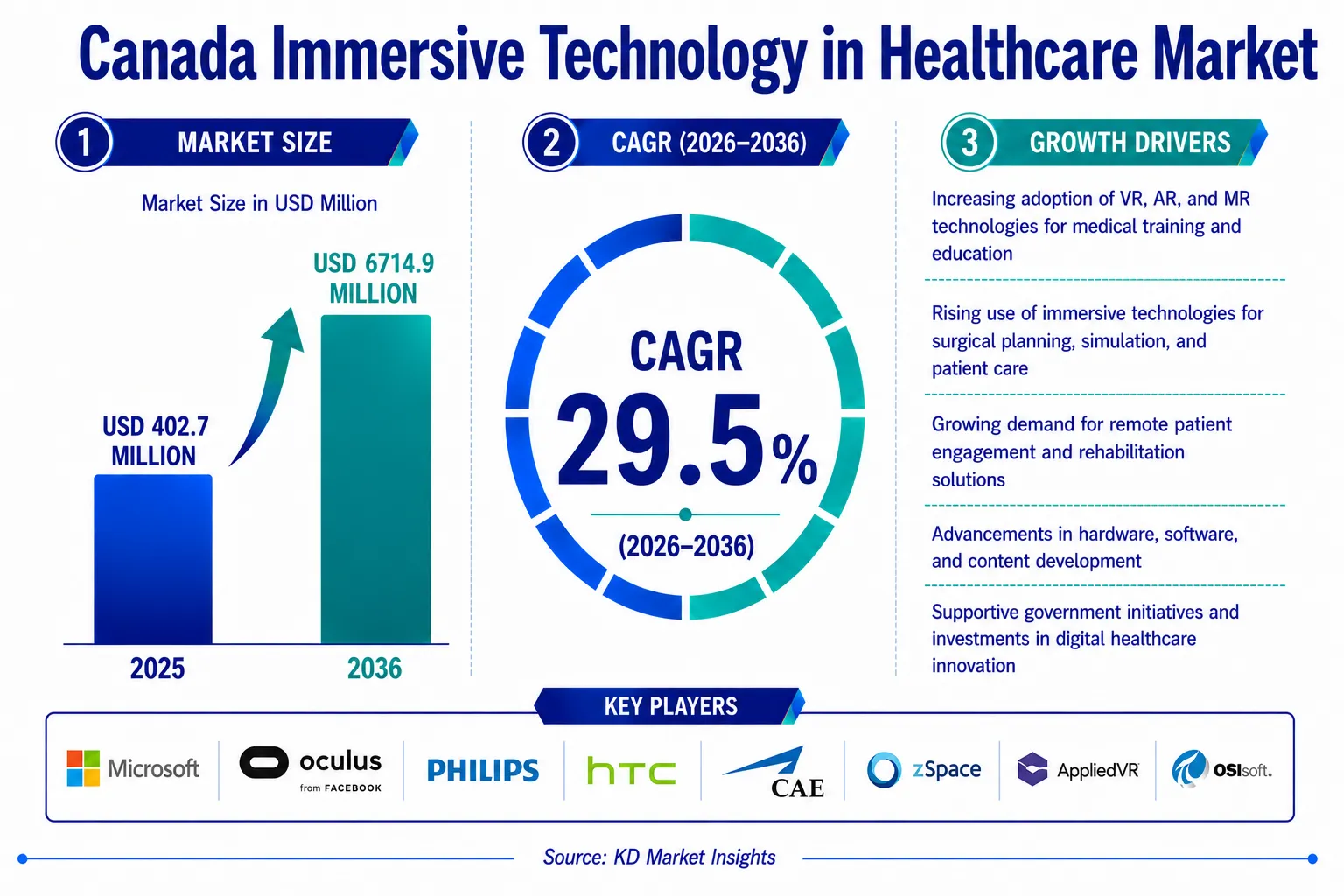
Canada immersive technology in healthcare market revenue to generate USD 6714.9 million by 2036, according to KDMI analyst’s growth analysis. The market is segmented by application, component, and technology.
Key Highlights
- 2025 Market Size: USD 402.7 million
- 2036 Forecast Market Size: USD 6714.9 million
- CAGR (2026–2036): 29.5%
- Largest Segment: VR-based medical training and education
- Fastest Growing: AR-guided surgery and MR-assisted healthcare
- Key Market Drivers: Digital health adoption, immersive medical training, AI integration, telemedicine, healthcare digitalization
- Key Players: Microsoft Corporation, Siemens Healthineers AG, GE HealthCare Technologies Inc., Philips Healthcare, Medtronic plc, HTC Corporation, Osso VR Inc., CAE Inc., Surgical Theater, LLC, XRHealth.
What is the Canada Immersive Technology in Healthcare Market Size?
As per the survey report on Canada immersive technology in healthcare market, the market is expected to foresee a CAGR value of 29.5% during 2026-2036, and further generate a market size of USD 6714.9 million by the end of 2036. In 2025, the market size was value at USD 402.7 million revenue.
- The Canada immersive technology in healthcare market’s growth is driven by increasing demand for remote healthcare services.
- KDMI analyst’s growth analysis foresees limited clinical validations as restraint for Canada immersive technology in healthcare market.
- In the Canada immersive technology in healthcare market, application segment is playing significant role.
Canada Immersive Technology in Healthcare Market Analysis
Immersive technology in healthcare refers to the use of Virtual Reality (VR), Augmented Reality (AR), and Mixed Reality (MR) to create interactive digital environments. It bridges the gap between digital data and physical realities, fundamentally transforming how medical professionals train, operate, and treat patients. The Canadian immersive technology in healthcare market is driven by the growing use of advanced technology in patient care, surgical simulation, and medical education. According to OECD report, nearly 73.7% of all primary care visits and 63.9% of specialty care visits were delivered virtually in the Q2 of 2020, compared to 1.8% of total ambulatory visits in Q4 of 2019. Also, 78% of the physicians agreed to provide quality care virtually, and more than two-thirds of physicians were satisfied with video visits. Furthermore, improvements in both hardware and software, including AI-powered VR platforms and high-resolution headsets, improve therapeutic efficacy and realism.
|
Canada Immersive Technology in Healthcare Market: Report Scope |
|
|
Base Year |
2025 |
|
Estimated Market Size |
USD 402.7 million in 2025 |
|
Forecast Year |
2026-2036 |
|
Projected Market Size |
USD 6714.9 million in 2036 |
|
CAGR Value |
29.5% |
|
Canada immersive technology in healthcare Market Key Trends/ Growth Drivers |
|
|
Restraint Factors
|
|
|
Canada immersive technology in healthcare Market Segmentation |
|
|
Canada immersive technology in healthcare Market Key Players |
|
Canada Immersive Technology in Healthcare Market Growth Drivers and Restraints
Growth Drivers
- Demand for remote healthcare solutions – The growing demand for remote healthcare solutions is a key driver of the Canada immersive technology in healthcare market. Canada’s vast geographical area and rapidly increasing aging population is driving demand for effective healthcare solutions. According to the ITA, currently Canada’s telehealth market reached approximately USD 2.5 million or 32% in 2025, which is further expected to grow to 37% by 2029. Additionally, both the supply and the demand for telemedicine services was established before COVID-19 pandemic, with over 4% of overall primary care consultations conducted remotely, according to RAND report. Technologies like augmented reality, virtual reality, and mixed reality enable healthcare professionals to deliver more interactive and personalized care without requiring physical visits, thereby improving patient engagement and treatment outcomes.
- Increase in healthcare investment – Rising healthcare investments from both government agencies and private organizations are contributing to the growth of the Canada immersive technology in healthcare market. According to Policy Options, Canada spends USD 265.5 million every year on healthcare services. Of every dollar, 70% is public while 30% is private. Public-sector share in hospital spending on healthcare services was 90.2% in 2019, with government spending reaching USD 1,593 per capita. Additionally, growing venture capital investments and collaborations between healthcare organizations and technology companies are driving innovation in immersive healthcare applications. Moreover, these investments accelerate product development across healthcare facilities, and strengthens Canada’s position as a leading adopter of next-generation healthcare technologies.
Restraints
- Limited clinical validation and standardization – The key restraint is that immersive technology application in healthcare services lacks universal acceptance due to stringent clinical standards and long-term validation studies. These regulations require healthcare providers to have evidence ensuring safety, effectiveness, and return on investment of immersive technologies, before its deployment. This causes technological variations in the market and reduces growth potential.
- Data privacy concerns – Immersive technologies like AI and ML often operate based on historical and sensitive patient information, which raises concerns regarding data privacy, cybersecurity, and regulatory compliance. Thus, concerns related to data breaches and unauthorized access creates significant barrier for market expansion.
Canada Immersive Technology in Healthcare Market Segmentation
Our experts at KD Market Insights have segmented the Canada immersive technology in healthcare market research report as:
|
By component |
|
|
By technology |
|
|
By application |
|
Analyst’s Observation on Canada Immersive Technology in Healthcare Market Recent Developments
Over the years, the experts at KD Market Insights have been observing the recent developments associated with Canada immersive technology in healthcare market trends. Our expert’s market forecast analysis has recorded the market players adopting plentiful of key strategies including new product launches, mergers & acquisitions, and collaborations.
On June 2, Realize Medical announced the appointment of Andrew Waitman to its Board of Directors. A transformative technology executive, venture capitalist, and company builder, Waitman brings more than 30 years of experience scaling high-growth technology companies into global enterprises. His expertise in SaaS, artificial intelligence, data platforms, and international business expansion will support Realize Medical.
On May 7, 2025, WELL Health Technologies Corp. announced that its subsidiary, WELLSTAR Technologies Corp. has launched Nexus AI™—a groundbreaking, Canadian-built artificial intelligence platform that seamlessly integrates with popular Canadian EMR systems. Nexus AI streamlines clinical workflows while reducing healthcare providers’ administrative burden and cognitive load.
Canada Immersive Technology in Healthcare Market Competitive Landscape
Some of the significant participants who top the Canada immersive technology in healthcare market growth:
- Immersive Healthcare
- Precision OS
- VR Vision Inc
- KINESIX. VR
- XpertVR
- Propel VR
- Pure Realism
- UP360
- Red Iron Labs
- GestureTek Health

Need Customized Report for Your Business ?
Utilize the Power of Customized Research Aligned with Your Business Goals
Request for Customized Report- Quick Contact -
- ISO Certified Logo -



Frequently Asked Questions(FAQ)
Canada Immersive Technology in Healthcare Market
-: Our Clients :-