United States Peripheral Vascular Devices Market
United States Peripheral Vascular Devices Market Size, Trends, Opportunity, and Forecast Analysis, 2026-2036
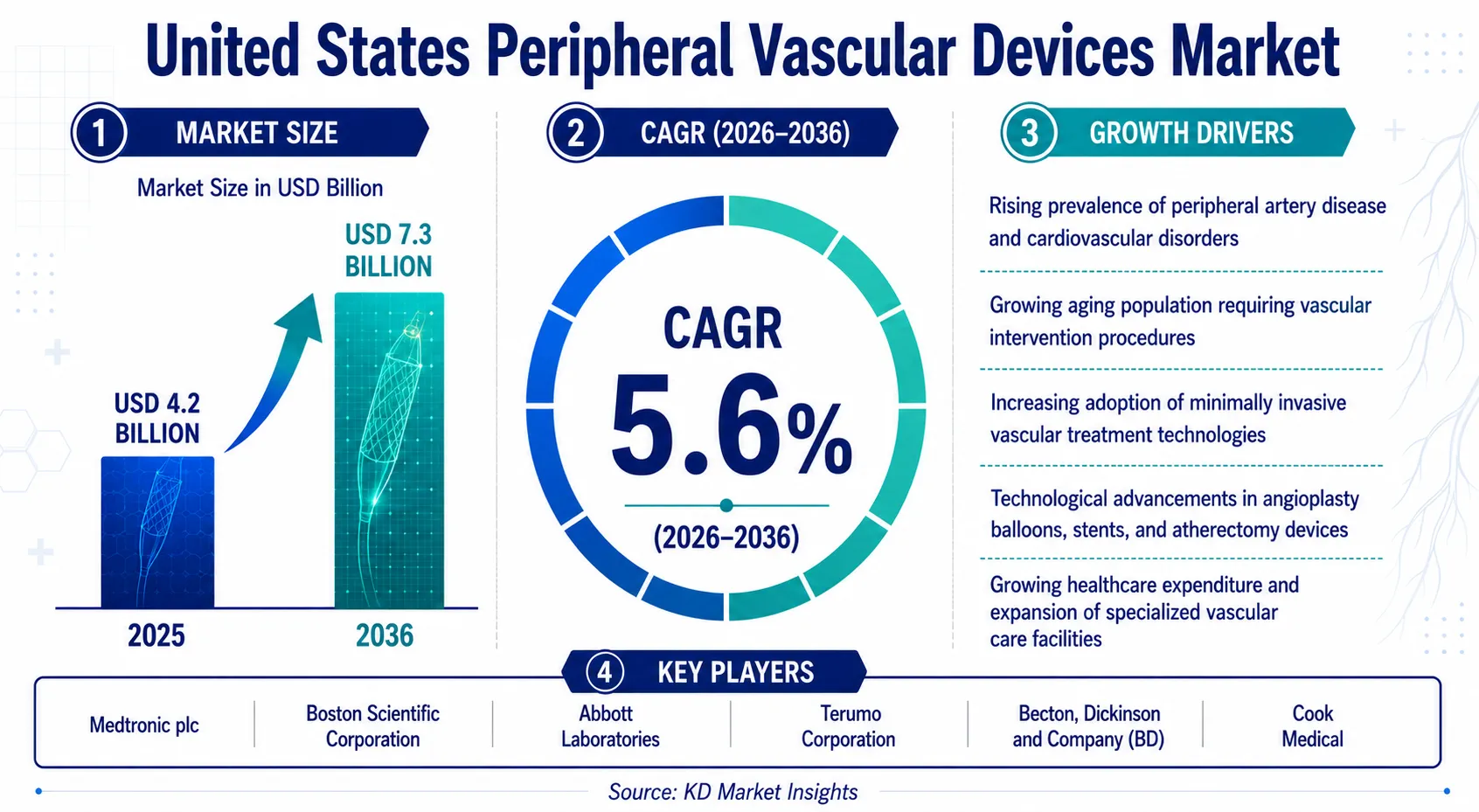
United States peripheral vascular devices market revenue to generate USD 7.3 billion by 2036, according to KDMI analyst’s growth analysis. The market is segmented by type, application, and end user.
Key Highlights
- 2025 Market Size: USD 4.2 billion
- 2036 Forecast Market Size: USD 7.3 billion
- CAGR (2026–2036): 5.6%
- Largest Segment: Angioplasty balloons and stents
- Fastest Growing: Drug-coated balloons and drug-eluting stents
- Key Market Drivers: Rising PAD prevalence, aging population, minimally invasive procedures, technological innovation
- Key Players: Medtronic plc, Boston Scientific Corporation, Abbott Laboratories, Becton, Dickinson and Company (BD), Terumo Corporation, Cook Medical, Cardinal Health, Inc., Teleflex Incorporated, Koninklijke Philips N.V., AngioDynamics, Inc.
What is the United States Peripheral Vascular Devices Market Size?
As per the survey report on United States peripheral vascular devices market, the market is expected to foresee a CAGR value of 5.6% during 2026-2036, and further generate a market size of USD 7.3 billion by the end of 2036. In 2025, the market size was value at USD 4.2 billion revenue.
- The United States peripheral vascular devices market’s growth is driven by rising prevalence of PAD.
- KDMI analyst’s growth analysis foresees risk of complication as restraint for United States peripheral vascular devices market.
United States Peripheral Vascular Devices Market Analysis
Peripheral vascular devices are medical tools and implants designed to diagnose and treat diseases of the blood vessels located outside the heart and brain, primarily in the limbs. These devices include stents, catheters, and angioplasty balloons, are typically used in minimally invasive, catheter-based procedures to restore blood flow, remove plaques, or manage blockages. The United States peripheral vascular devices market growth is driven by increasing prevalence of venous diseases or Chronic Venous Insufficiency (CVI). According to Journal report, the prevalence of peripheral artery disease (PAD) indicates that around 7 to 12 million individuals are affected across the United States. PAD rates are rapidly rising with highest prevalence in individuals aged above 70 years. Furthermore, growing geriatric population, and increasing demand for minimally invasive endovascular procedures is further increasing its adoption and driving market growth.
|
United States Peripheral Vascular Devices Market: Report Scope |
|
|
Base Year |
2025 |
|
Estimated Market Size |
USD 4.2 billion in 2025 |
|
Forecast Year |
2026-2036 |
|
Projected Market Size |
USD 7.3 billion in 2036 |
|
CAGR Value |
5.6% |
|
United States peripheral vascular devices Market Key Trends/ Growth Drivers |
|
|
Restraint Factors
|
|
|
United States peripheral vascular devices Market Segmentation |
|
|
United States peripheral vascular devices Market Key Players |
|
United States Peripheral Vascular Devices Market Growth Drivers and Restraints
Growth Drivers
- Rising prevalence of chronic diseases – The increasing prevalence of peripheral artery disease (PAD) and other chronic conditions such as diabetes, obesity, and cardiovascular disorders, is a significant driver for peripheral vascular devices market. According to CDC report, heart disease is leading cause of death among United States population. In 2023, approximately 9 lakh people died from cardiovascular disease, which is equivalent to 1 in every 3 deaths. Additionally, 3 in four American adults have at least one chronic condition, and more than half of the population have two or more chronic conditions. This growing patient pool is driving demand for diagnostic and interventional devices such as angioplasty balloons, stents, catheters, and atherectomy systems. Moreover, strong emphasis of healthcare providers for early detection and timely treatment of vascular diseases is further accelerating device adoption.
- Favorable healthcare infrastructure – Another key factor driving demand for peripheral vascular devices is the well-established healthcare infrastructure and favorable reimbursement policies across the United States. According to the National Health Expenditure Accounts (NHEA) estimates, total U.S healthcare spending reached USD 5.3 trillion per person, up by 7.2% in 2024. Also, another report suggests, around 92.0% of 320 million people had health insurance as of 2024. Private health insurance coverage was more prevalent than public coverage, representing an increase of 0.7% from 2023. Strong adoption of insurance policies encourages patients to undergo diagnosis and treatment. This supportive ecosystem enables higher procedure volumes and drives continuous demand for vascular devices across healthcare facilities and private clinics.
Restraints
- High cost of devices and procedures – High costs associated with advanced peripheral vascular devices and treatments poses as a barrier for cost-sensitive patients to adopt. Limited insurance coverage and increasing out-of-pocket expenses limit patient access to advanced devices and reduces procedure volumes, thereby impacting market expansion.
- Risk of complication and device failures – Another key restraint is the risks associated with device complications such as restenosis, thrombosis, infection, and device failures. These risks can affect patient outcomes and also leads to delay in complete recovery, which discourages patients and healthcare providers to adopt, thereby limiting market growth potential.
United States Peripheral Vascular Devices Market Segmentation
Our experts at KD Market Insights have segmented the United States peripheral vascular devices market research report as:
|
By type |
|
|
By application |
|
|
By end user |
|
Analyst’s Observation on United States Peripheral Vascular Devices Market Recent Developments
Over the years, the experts at KD Market Insights have been observing the recent developments associated with United States peripheral vascular devices market trends. Our expert’s market forecast analysis has recorded the market players adopting plentiful of key strategies including new product launches, mergers & acquisitions, and collaborations.
Boston Scientific Corporation has announced to receive FDA clearance to launch its Sterling™ Monorail® and Over-the-Wire Balloon Dilatation Catheter in the United States. The Sterling Balloon Dilatation Catheter sets a new standard in peripheral angioplasty with its ultra-low-profile balloon. They are designed to meet the challenges of the peripheral vasculature.
Stryker has announced to acquisition of Amplitude Vascular Systems, Inc. The acquisition will strengthen Stryker’s Peripheral Vascular (PV) portfolio by adding revascularization technology. AVS’ technology is designed to use pulsed CO₂-generated pressure waves uniformly delivered through an IVL balloon catheter, to fracture calcium and optimize luminal gain. The platform is designed to enhance catheter deliverability, treatment speed and therapy efficiency.
United States Peripheral Vascular Devices Market Competitive Landscape
Some of the significant participants who top the United States peripheral vascular devices market growth:
- Abbott
- Terumo Medical Corporation
- Medtronic
- Boston Scientific Corporation
- Cordis
- Koninklijke Philips N.V.
- AngioDynamics, Inc.
- Asahi Intecc Co. Ltd.
- BD
- BIOTRONIK SE & Co. KG
- Biosensors International Group Ltd.
- B. Braun SE
- iVascular
- Merit Medical Systems, Inc.
- Cook Group Inc

Need Customized Report for Your Business ?
Utilize the Power of Customized Research Aligned with Your Business Goals
Request for Customized Report- Quick Contact -
- ISO Certified Logo -



Frequently Asked Questions(FAQ)
United States Peripheral Vascular Devices Market
-: Our Clients :-