United States Distributed Energy Resource Management Market
United States Distributed Energy Resource Management Market Size, Trends, Opportunity, and Forecast Analysis, 2026-2036
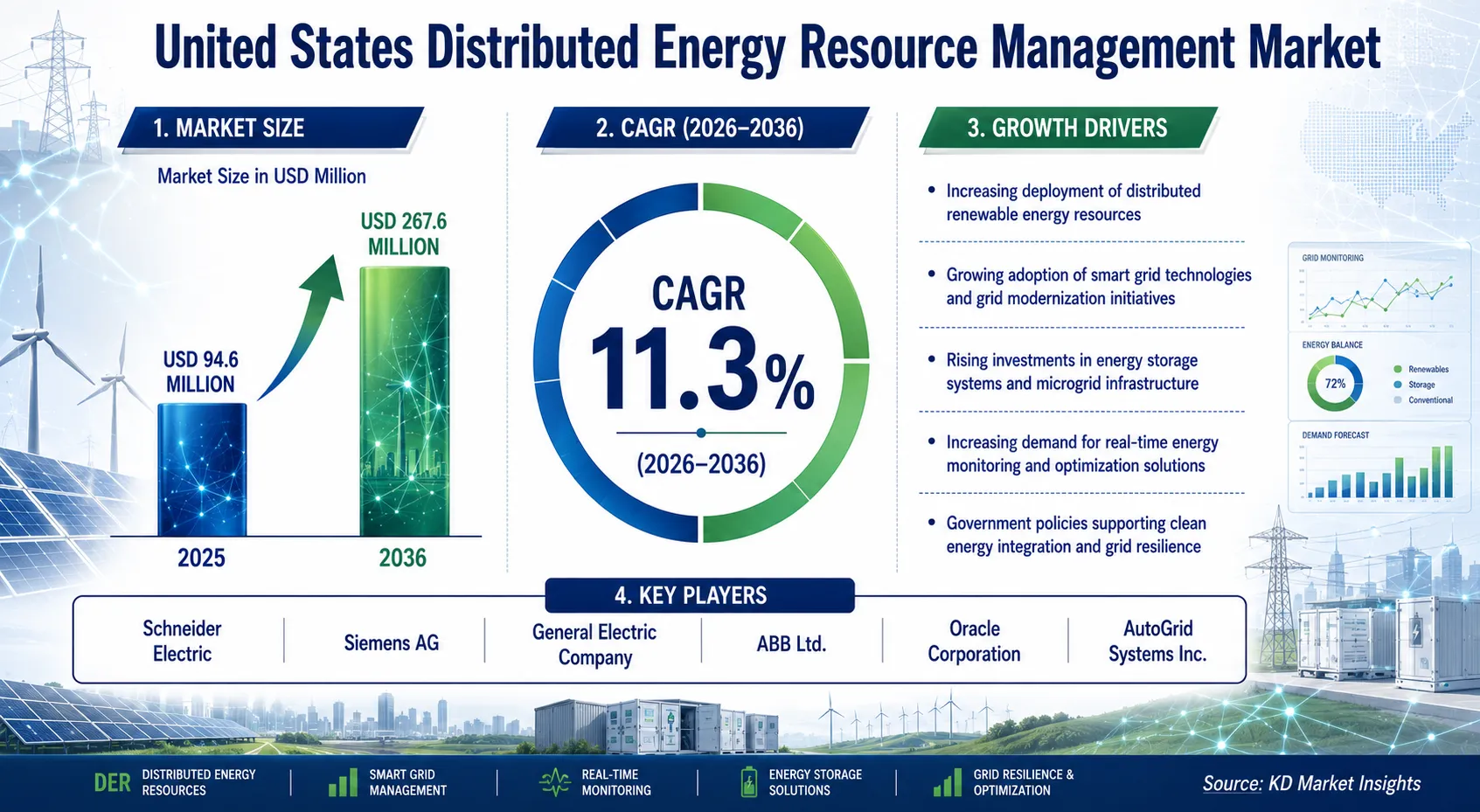
United States distributed energy resource management market revenue to generate USD 267.6 million by 2036, according to KDMI analyst’s growth analysis. The market is segmented by application, component, deployment mode, type, and end user.
Key Highlights
- 2025 Market Size: USD 94.6 million
- 2036 Forecast Market Size: USD 267.6 million
- CAGR (2026–2036): 11.3%
- Largest Segment: DERMS software platforms
- Fastest Growing: Cloud-based DERMS and Virtual Power Plant solutions
- Key Market Drivers: Renewable energy expansion, smart grid investments, EV adoption, AI-powered energy management
- Key Players: Schneider Electric, Siemens AG, GE Vernova, ABB Ltd., Oracle Corporation, AutoGrid Systems, Enbala Power Networks, Itron Inc., Open Access Technology International (OATI), EnergyHub.
What is the United States Distributed Energy Resource Management Market Size?
As per the survey report on United States distributed energy resource management market, the market is expected to foresee a CAGR value of 11.3% during 2026-2036, and further generate a market size of USD 267.6 million by the end of 2036. In 2025, the market size was value at USD 94.6 million revenue.
- The United States distributed energy resource management market’s growth is driven by growing demand for energy resilience.
- KDMI analyst’s growth analysis foresees cybersecurity concerns as restraint for United States distributed energy resource management market.
- In the United States distributed energy resource management market, component segment is playing significant role.
United States Distributed Energy Resource Management Market Analysis
A distributed energy resource management (DERM) refers to the software platforms, control systems, and technologies. They are used to coordinate, monitor, and optimize small-scale, decentralized energy assets such as rooftop solar panels, battery storage, electric vehicles (EVs), and smart appliances, that are connected to the power grid. The United States DERM market is driven by the increasing integration of renewable energy sources and technological advancements. According to the EIA report, total energy consumption in 2025 was around 4.20 trillion kWh, increased by 14 times than electricity used in 1950. Also, total direct-use electricity by the industrial and commercial sectors was about 3.3% of total electricity end-use consumption in 2025 . Additionally, renewable energy use is further projected to grow by 3.5% from 2024 to 2050, with renewables projected to provide 22% of U.S. energy use by 2050. Moreover, the rising investments in utilities and grid infrastructure is accelerating market adoption.
|
United States Distributed Energy Resource Management Market: Report Scope |
|
|
Base Year |
2025 |
|
Estimated Market Size |
USD 94.6 Million in 2025 |
|
Forecast Year |
2026-2036 |
|
Projected Market Size |
USD 267.6 Million in 2036 |
|
CAGR Value |
11.3% |
|
United States distributed energy resource management Market Key Trends/ Growth Drivers |
|
|
Restraint Factors
|
|
|
United States distributed energy resource management Market Segmentation |
|
|
United States distributed energy resource management Market Key Players |
|
United States Distributed Energy Resource Management Market Growth Drivers and Restraints
Growth Drivers
- Growing demand for energy resilience – The increasing need for energy resilience and modernization of aging power infrastructure is a key growth driver for the United States distributed energy resource management market. Frequent extreme weather events, power outrage, and rising electricity demand are encouraging utilities and grid operators to adopt advanced DERM solutions for improved grid stability and operational efficiency. According to the Infrastructure Report Card 2025, data centers alone will require approximately 35 GW of electricity by 2030, up from 17 GW in 2022, growing by nearly 10% per year. The Infrastructure Investment and Jobs Act (IIJA) has allocated USD 73 billion to modernize the electric grid. Additionally, data centers require enough energy to power approximately 80,000 U.S homes. To meet the nation’s electricity needs, the Department of Energy (DOE) has created the North American Energy Resilience Model (NAERM). Therefore, rising government investments in smart grid development is further supporting growth of DERM market.
- Increasing EV charging penetration – The rapid expansion of electric vehicles (EV) adoption and charging infrastructure in the United States is further driving the growth of the distributed energy resource management market. As the number of EV charging station increases, utilities are facing higher electricity loads and greater demand variability on distribution networks. According to the U.S Department of Energy data, the number of electric vehicles (EVs) are projected to reach 33 million units, along with 28 million EV charging ports need. Of these 28 million charging ports, 25.7 million are expected to be private Level 1 (L1) and level 2 (L2) chargers at single-family homes. Also, there will be 2.1 million public and private L2 chargers at multifamily homes, thereby further encouraging utilities to invest in advanced DERM platforms.
Restraints
- Cybersecurity and data privacy concerns – The key restraint is the growing digitalization of energy management system has increased concerns regarding cybersecurity and data privacy. As DERM platforms rely heavily on interconnected devices, cloud-based systems, and real-time data exchange, which makes them vulnerable to cyberattacks, data breaches, and operational disruptions. Therefore, this challenge limits adoption of advanced DERM system across industrial sectors.
- Grid infrastructure complexity – Another key restraint is managing rapidly growing number of distributed energy resources across an already complex and aging grid infrastructure. Utilities often face challenges in coordinating renewable energy systems with legacy systems, which can create operational inefficiencies, thereby slowing adoption of DERM solution in the United States.
United States Distributed Energy Resource Management Market Segmentation
Our experts at KD Market Insights have segmented the United States distributed energy resource management market research report as:
|
By Component |
|
|
By Deployment Mode |
|
|
By Type |
|
|
By Application |
|
|
By End User |
|
United States Distributed Energy Resource Management Market Competitive Landscape
Some of the significant participants who top the United States distributed energy resource management market growth:
- Siemens
- Schneider Electric
- General Electric
- Honeywell
- ABB
- Enphase Energy
- Sungrow Power Supply
- NextEra Energy
- Eaton
- Enel X

Need Customized Report for Your Business ?
Utilize the Power of Customized Research Aligned with Your Business Goals
Request for Customized Report- Quick Contact -
- ISO Certified Logo -



Frequently Asked Questions(FAQ)
United States Distributed Energy Resource Management Market
-: Our Clients :-