South Korea Telecom Market
South Korea Telecom Market Size, Trends, Opportunity, and Forecast Analysis, 2026-2036
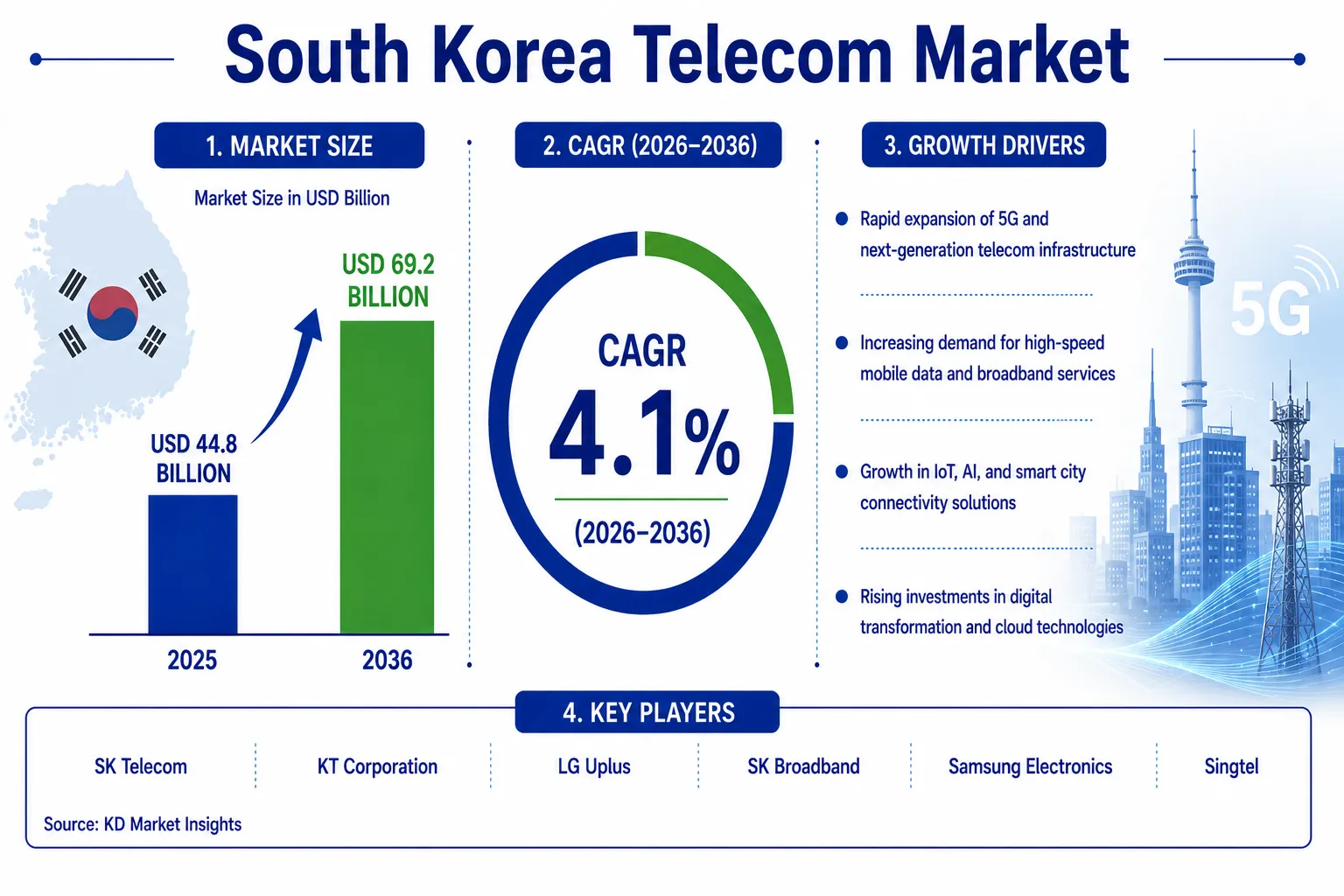
South Korea telecom market revenue to generate USD 69.2 billion by 2036, according to KDMI analyst’s growth analysis. The market is segmented by service, end user, and distribution channel.
Key Highlights
- 2025 Market Size: USD 44.8 Billion
- 2036 Forecast Market Size: USD 69.2 Billion
- CAGR (2026–2036): 4.1%
- Largest Market: Mobile telecom services
- Fastest Growing Region: Enterprise 5G & private networks
- Key Market Drivers: 5G rollout, AI integration, enterprise connectivity demand
- Market Structure: Highly concentrated telecom oligopoly led by SK Telecom, KT, and LG Uplus
- Key Players: SK Telecom, KT Corporation, LG Uplus, SK Broadband, LG HelloVision, Samsung Networks.
What is the South Korea Telecom Market Size?
As per the survey report on South Korea telecom market, the market is expected to foresee a CAGR value of 4.1% during 2026-2036, and further generate a market size of USD 69.2 billion by the end of 2036. In 2025, the market size was value at USD 44.8 billion revenue.
- The South Korea telecom market’s growth is driven by increasing smartphone penetration.
- KDMI analyst’s growth analysis foresees regulatory challenges as restraint for South Korea telecom market.
South Korea Telecom Market Analysis
Telecom or telecommunications is the service of exchanging set of information over significant distances using electronic means, including voice, data, and video transmission. This service involves infrastructures such as cables, fiber optics, radio waves, and satellites to connect users via telephones, the internet, and broadcasting. The South Korea telecom market is experiencing significant growth driven by rapid adoption of 5G technology, increasing demand for mobile data services, and the expansion of IoT applications across various sectors. According to the worlddata report, in 2025, the total cost calculated for South Korea’s mobile phone rates were USD 22.70. According to OECD, total cost in telecommunication sector has rose by 0.6% between March 2025 and March 2026. Furthermore, rising investment in infrastructure and technology has enhanced connectivity and service delivery across South Korea.
|
South Korea Telecom Market: Report Scope |
|
|
Base Year |
2025 |
|
Estimated Market Size |
USD 44.8 billion in 2025 |
|
Forecast Year |
2025-2035 |
|
Projected Market Size |
USD 69.2 billion in 2036 |
|
CAGR Value |
4.1% |
|
South Korea telecom Market Key Trends/ Growth Drivers |
|
|
Restraint Factors
|
|
|
South Korea telecom Market Segmentation |
|
|
South Korea telecom Market Key Players |
|
South Korea Telecom Market Growth Drivers and Restraints
Growth Drivers
- Increasing smartphone adoption – South Korea has one of the highest smartphone adoption rates globally, driven by tech-savvy population and rapid device upgrade cycles. According to research, smartphone penetration has exceeded 90% in 2020, with ownership share reaching 97% and 5% have a regular mobile phone. The ownership and smartphone penetration rates are further supported by strong presence of brands like Samsung Electronics and Apple Inc, which has significantly increased mobile data consumption. As consumers are increasingly engaging in broadcasting activities such as OTT streaming, mobile gaming, digital payments, and social media, which have further increased smartphone penetration across South Korea. Moreover, the integration of advanced features like AI-enabled applications, high-resolution video streaming, and augmented reality in smartphones further accelerates data usage, compelling telecom operators to enhance network capacity and service offering. This strong device ecosystem is a key market driver.
- Expansion of 5G networks – South Korea is the global leader in 5G deployment, with nationwide coverage led by leading operators such as SK Telecom, KT Corporation, and LG Uplus. According to SAMENA, the number of 5G users has reached 11.85 million in 2020, accounting for an increase of 8.4% . The continuous expansion and densification of 5G infrastructure are enabling ultra-low latency, high-speed connectivity, and massive device connectivity. This further supports emerging technologies such as smart cities, autonomous vehicles, industrial IoT, and immersive media. Moreover, telecom companies are increasingly investing in standalone 5G architecture and edge computing, which enhances network efficiency and unlocks new enterprise use cases like private networks and mission-critical communications. The government’s proactive support for next-generation technologies, including early-stage 6G developments, further boosts long-term market growth.
Restraints
- High capital expenditure – One of the major restraints is the requirement of continuous investment in 5G infrastructure, spectrum acquisition, and network upgrades. This puts financial pressure on telecom operators, which also impact profitability on large volume and limit overall market growth.
- Regulatory and security challenges – Stringent regulations, spectrum fees, foreign ownership limits, and other such factors increase overall complexities across South Korea. This leads to increase in operational costs and emphasize manufacturers to go-through long approval procedures, thereby limiting market expansion.
South Korea Telecom Market Segmentation
Our experts at KD Market Insights have segmented the South Korea telecom market research report as:
|
By service |
|
|
By end user |
|
|
By distribution channel |
|
Analyst’s Observation on South Korea Telecom Market Recent Developments
Over the years, the experts at KD Market Insights have been observing the recent developments associated with South Korea telecom market trends. Our expert’s market forecast analysis has recorded the market players adopting plentiful of key strategies including new product launches, mergers & acquisitions, and collaborations.
SK Telecom has announced its evolution into a comprehensive artificial intelligence data center (AIDC) developer and entering the global market. SK Telecom plans to build additional global partnerships and make further investments in its Ulsan AIDC, expanding it to a 1 GW-scale capacity.
KT Corporation will launch a bundled mobile plan offering YouTube Premium Lite, becoming the first telecom operator in South Korea to do so. The new product is a revision of the existing "YouTube Premium Choice" plan, replacing the standard YouTube Premium benefit with YouTube Premium Lite.
South Korea Telecom Market Competitive Landscape
Some of the significant participants who top the South Korea telecom market growth:
- SK Telecom Co., Ltd.
- KT Corporation
- LG Uplus Corp.
- Samsung Electronics Co., Ltd.
- SK Broadband Co., Ltd.
- LG HelloVision Corp.
- KT Skylife Co., Ltd.
- D'LIVE Co., Ltd.
- T-Broad Co., Ltd.
- KCT Co., Ltd.
- CJ ENM Co., Ltd.
- Hanaro Telecom Inc. (now part of SK Broadband)
- Naver Corporation
- Kakao Corp.
- Tmap Mobility Co., Ltd

Need Customized Report for Your Business ?
Utilize the Power of Customized Research Aligned with Your Business Goals
Request for Customized Report- Quick Contact -
- ISO Certified Logo -



Frequently Asked Questions(FAQ)
South Korea Telecom Market
-: Our Clients :-