South Korea Enterprise Artificial Intelligence Market
South Korea Enterprise Artificial Intelligence Market Size, Trends, Opportunity, and Forecast Analysis, 2026-2036
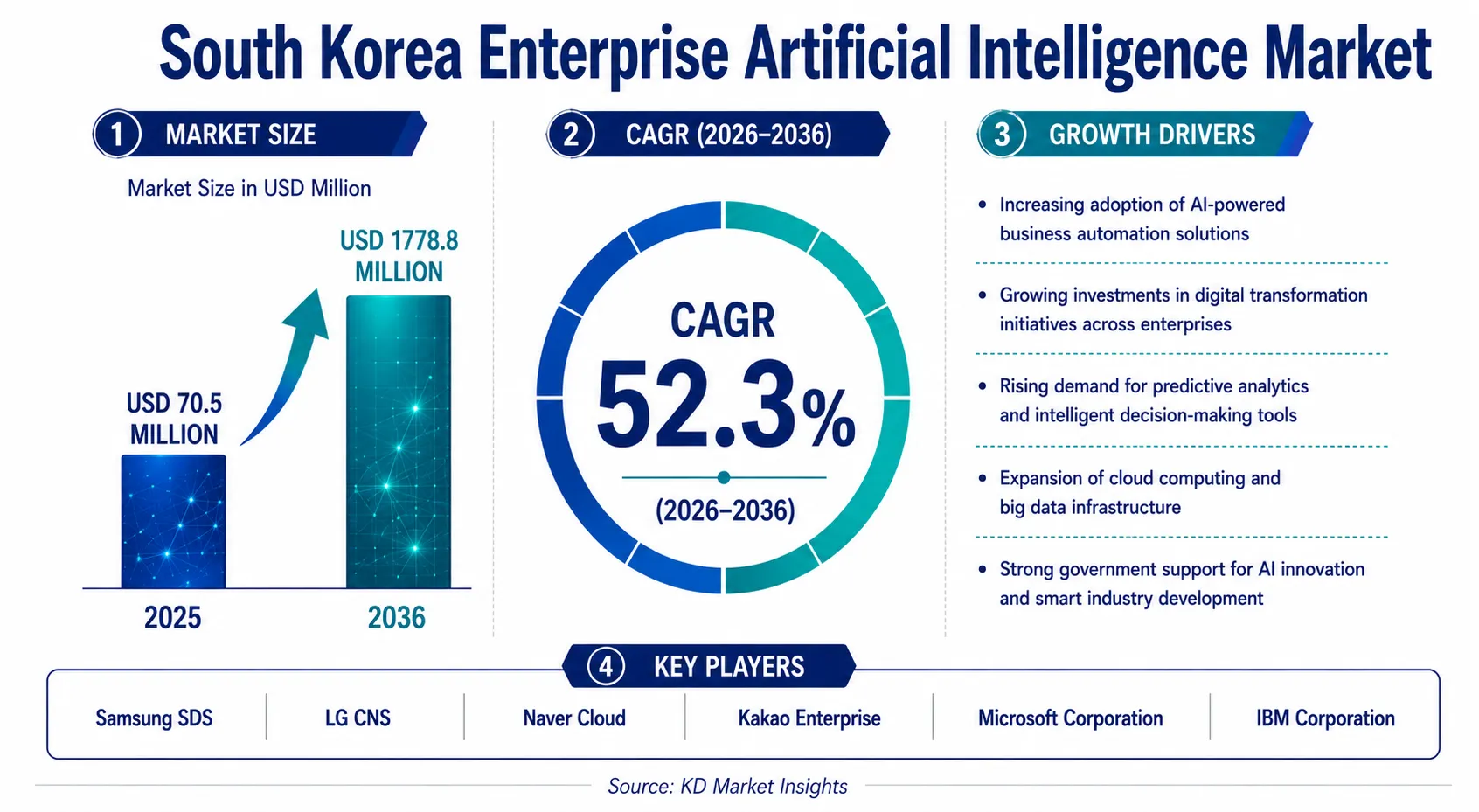
South Korea enterprise artificial intelligence market revenue to generate USD 1778.8 million by 2036, according to KDMI analyst’s growth analysis. The market is segmented by solution, service, deployment, and industry.
Key Highlights
- 2025 Market Size: USD 70.5 million
- 2036 Forecast Market Size: USD 1778.8 million
- CAGR (2026–2036): 52.3%
- Largest Segment: AI software and enterprise platforms
- Fastest Growing: Generative AI and intelligent automation solutions
- Growth Drivers: Digital transformation, AI innovation, cloud adoption, Industry 4.0 initiatives
- Key Players: Samsung SDS, LG CNS, Naver Cloud, KT Corporation, SK Telecom, Microsoft Corporation, Google Cloud, IBM Corporation, SAP SE, Oracle Corporation.
What is the South Korea Enterprise Artificial Intelligence Market Size?
As per the survey report on South Korea enterprise artificial intelligence market, the market is expected to foresee a CAGR value of 52.3% during 2026-2036, and further generate a market size of USD 1778.8 million by the end of 2036. In 2025, the market size was value at USD 70.5 million revenue.
- The South Korea enterprise artificial intelligence market’s growth is driven by adoption of AI in enterprises.
- KDMI analyst’s growth analysis foresees data privacy concerns as restraint for South Korea enterprise artificial intelligence market.
- In the South Korea enterprise artificial intelligence market, solution segment is playing significant role.
South Korea Enterprise Artificial Intelligence Market Analysis
Enterprise artificial intelligence (AI) refers to the integration of advanced AI-enabled technologies and techniques within large organizations to enhance business functions. It is essential for performing routine tasks such as data collection and analysis, also more complex operations such as automation, customer service, and risk management. The South Korean market is experiencing significant growth driven by increasing investments in artificial intelligence and rapid adoption of industry 4.0 initiatives across leading sectors. According to the ITA, the Korean government allocated USD 1.9 million into R&D projects to incentivize SME companies to advance and upscale automated technology in 2022. Under the automation goal, the country aims for 2,000 new AI-powered smart factories to be established by 2030. Therefore, the significant shift toward integration of AI into core business operations is accelerating market expansion.
|
South Korea Enterprise Artificial Intelligence Market: Report Scope |
|
|
Base Year |
2025 |
|
Estimated Market Size |
USD 70.5 million in 2025 |
|
Forecast Year |
2026-2036 |
|
Projected Market Size |
USD 1778.8 million in 2036 |
|
CAGR Value |
52.3% |
|
South Korea enterprise artificial intelligence Market Key Trends/ Growth Drivers |
|
|
Restraint Factors
|
|
|
South Korea enterprise artificial intelligence Market Segmentation |
|
|
South Korea enterprise artificial intelligence Market Key Players |
|
South Korea Enterprise Artificial Intelligence Market Growth Drivers and Restraints
Growth Drivers
- Adoption of AI in enterprises – One of the key factors driving demand for integration of artificial intelligence in the enterprises is the growing organizational complexities and rapid automation of technologies. According to OECD report, 37% of Korean SMEs faced intense labor shortage in the last two years, and 27% of participants say that generative AI will help to compensate for these shortages. By October 2025, 56.5% of Korean firms have adopted AI into businesses to replace specific tasks within existing jobs. Additionally, organizations are leveraging AI into businesses operations to enhance customer engagement, operational efficiency, data analysis, and reduce labor costs. Moreover, the Ministry of SMEs and Startups allocated KRW 1.2 trillion for AI in small businesses in 2024 .
- Rising investments and government support – Another significant factor driving demand for integration of AI in Korean businesses is the growing investment from public-private partnerships or government-led initiatives. Under the South Korea’s Digital New Deal, approximately KRW 160 trillion were allocated as investment in AI, big data, and cloud by 2025. Additionally, the government plans to establish over 10 national AI research institutes by 2027, with a budget of KRW 500 million. This support encourages private institutions to invest in automated technologies. Government-led initiatives further reshape the enterprise artificial intelligence market by implementing various policies aiming to promote AI research and development. In 2024, the government allocated KRW 1.1 trillion for AI R&D in the budget, up by 19.5% from 2023 . Therefore, continuous innovation in technological advancements further drives market growth.
Restraints
- Data privacy and regulatory concerns – One of the key restraints is data privacy and regulatory concerns associated with data shared or used by artificial intelligence (AI) tools for analytics and decision making. Additionally, sensitive or confidential data used for AI model training further raises data security concerns, which limits market expansion in large enterprises.
- Shortage of skilled AI professionals – Another key restraint is that advanced AI models development, deploying, and management requires highly trained and experienced professionals. The demand for qualified AI talent recruitment in large enterprises often face challenge, which can delay in AI implementation and reduce digital efficiency of businesses, thereby limiting market adoption.
South Korea Enterprise Artificial Intelligence Market Segmentation
Our experts at KD Market Insights have segmented the South Korea enterprise artificial intelligence market research report as:
|
By solution |
|
|
By service |
|
|
By deployment |
|
|
By industry |
|
Analyst’s Observation on South Korea Enterprise Artificial Intelligence Market Recent Developments
Over the years, the experts at KD Market Insights have been observing the recent developments associated with South Korea enterprise artificial intelligence market trends. Our expert’s market forecast analysis has recorded the market players adopting plentiful of key strategies including new product launches, mergers & acquisitions, and collaborations.
On 26th May, The Korea Federation of Small and Medium Enterprises Seoul regional headquarters said that it held the "small corporations artificial intelligence (AI) transition strategy conference" at the Small and Medium Business DMC Tower in Sangam-dong. The conference was prepared to support digital transition strategies for small and medium corporations and micro manufacturers and small merchants, which are relatively marginalized in AI use.
Also, SK Telecom has announced that it has signed a Memorandum of Understanding (MOU) with the Ministry of National Defense (MND) on “Applying the Ministry of Science and ICT (MSIT)’s Sovereign AI Foundation Model to Defense Sector” to accelerate defense AI transformation (AX). This agreement marks the first application of MSIT’s Sovereign AI Foundation Model Project in the defense sector.
South Korea Artificial Intelligence Market Competitive Landscape
Some of the significant participants who top the South Korea artificial intelligence market growth:
- Microsoft
- IBM
- Amazon
- Salesforce
- SAP
- NVIDIA
- Oracle
- C3.ai
- Siemens
- Naver
- Intel Corporation
Need Customized Report for Your Business ?
Utilize the Power of Customized Research Aligned with Your Business Goals
Request for Customized Report- Quick Contact -
- ISO Certified Logo -



Frequently Asked Questions(FAQ)
South Korea Enterprise Artificial Intelligence Market
-: Our Clients :-