North America Oil Storage Market
North America Oil Storage Market Size, Trends, Opportunity, and Forecast Analysis, 2026-2036
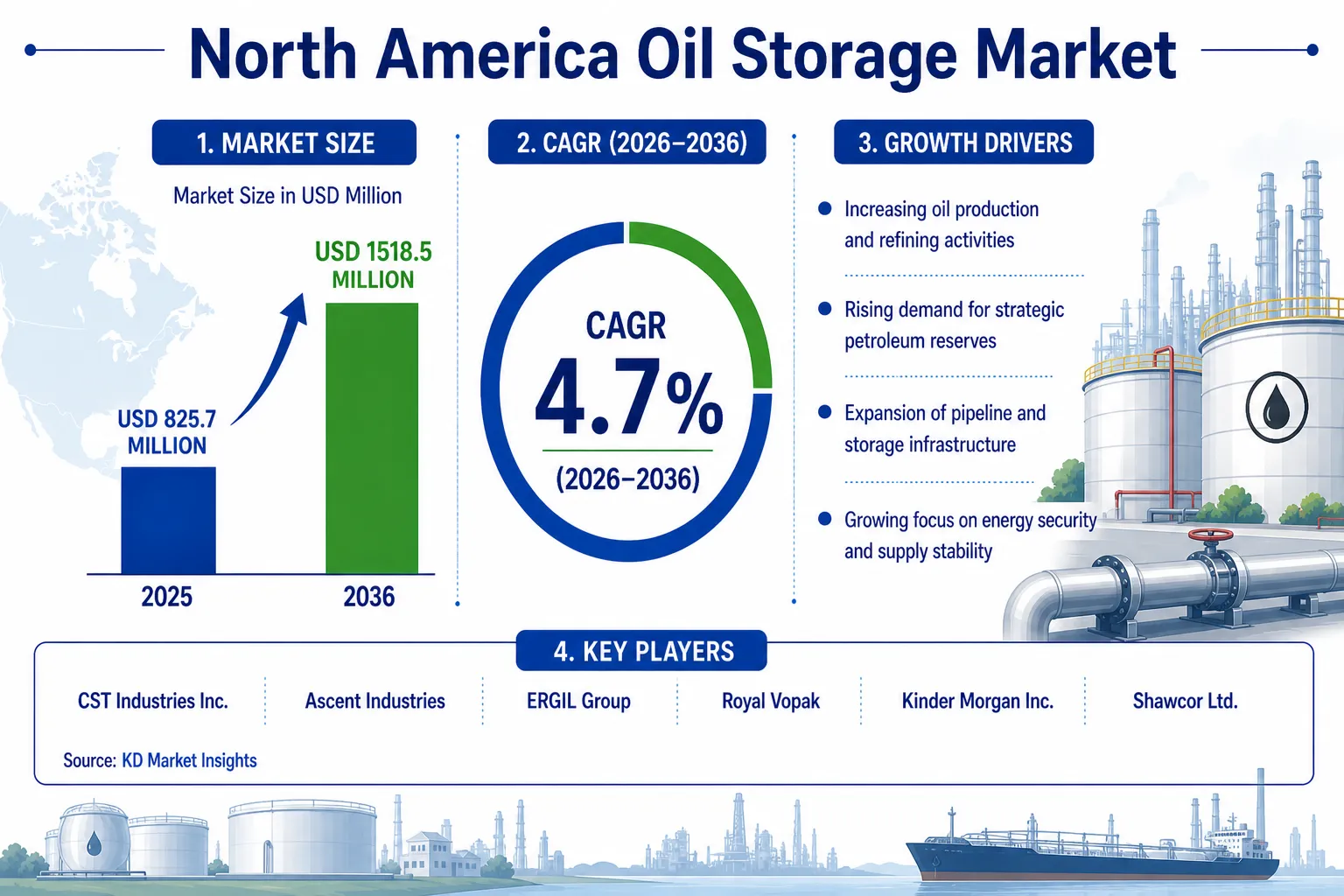
North America oil storage market revenue to generate USD 1518.5 million by 2036, according to KDMI analyst’s growth analysis. The market is segmented by type, material, and product design.
Key Highlights
- 2025 Market Size: USD 825.7 Million
- 2036 Forecast Market Size: USD 1518.5 Million
- CAGR (2026–2036): 4.7%
- Largest Market: United States
- Fastest Growing Region: Canada
- Key Market Drivers: Oil production, exports, energy security, infrastructure expansion.
- Key Players: Royal Vopak, Kinder Morgan, Magellan Midstream Partners, CST Industries, NOV Inc., Shawcor, Snyder Industries.
What is the North America Oil Storage Market Size?
As per the survey report on North America oil storage market, the market is expected to foresee a CAGR value of 4.7% during 2026-2036, and further generate a market size of USD 1518.5 million by the end of 2036. In 2025, the market size was value at USD 825.7 million revenue.
- The North America oil storage market’s growth is driven by rising demand for oil consumption.
- KDMI analyst’s growth analysis foresees infrastructural challenges as restraint for North America oil storage market.
What is Oil Storage?
Oil storage refers to storing of crude oil, refined products, and petrochemicals in tankers or terminals, above-ground or underground. It serves as a vital buffer between extraction, refining, and distribution, managing supply chain bottlenecks, ensuring consistent supply, and facilitating long-term strategic national reserves. The North America oil storage market is experiencing potential growth due to rise in shale oil production and the expansion of pipelines that have necessitated the development of infrastructure to support oil storage and manage surpluses. The region accounted for 27% of total crude oil production worldwide. Domestic crude oil production accounts for 110% share in total crude oil supply in 2023 . Moreover, rising exports of crude and refined products are further encouraging oil and gas companies to invest in development of oil storage infrastructure, thereby driving overall market demand.
|
North America Oil Storage Market: Report Scope |
|
|
Base Year |
2025 |
|
Estimated Market Size |
USD 825.7 million in 2025 |
|
Forecast Year |
2025-2035 |
|
Projected Market Size |
USD 1518.5 million in 2036 |
|
CAGR Value |
4.7% |
|
North America oil storage Market Key Trends/ Growth Drivers |
|
|
Restraint Factors
|
|
|
North America oil storage Market Segmentation |
|
|
North America oil storage Market Key Players |
|
North America Oil Storage Market Growth Drivers and Restraints
Growth Drivers
- Rising demand for oil and gas consumption - Sustained demand for petroleum products across North America continues to be a fundamental driver for oil storage infrastructure. The transportation sector remains the largest consumer, with gasoline, diesel, and jet fuel usage supported by high vehicle ownership rates, extensive logistics networks, and a strong aviation industry. In addition, industrial activities such as petrochemicals, manufacturing, and construction rely heavily on oil-derived inputs, further reinforcing consumption levels. The United States alone accounts for a significant share of global petroleum consumption, often exceeding 19 million barrels per day. Moreover, disruptions in supply chains, whether due to extreme weather events, refinery outages, or geopolitical tensions, necessitate buffer storage to prevent shortages, making storage infrastructure a critical backbone of the energy ecosystem.
- Expansion of refining capacities and midstream infrastructure – In the region, the US leads global renewable production capacity, which is estimated to reach 8,989 million gallons per year by 2028, while Canada is the third-highest renewable refinery capacity additions of 1,671 million gallons per year by 2028 . The ongoing expansion and modernization of refining capacities across North America are significantly boosting demand for oil storage solutions. Refineries are increasingly being upgraded to process a wider variety of crude types, including heavier and unconventional grades from shale formations, leading to higher throughput volumes. This expansion requires additional storage capacity for both incoming crude oil and outgoing refined products such as gasoline, diesel, and petrochemicals. Simultaneously, the development of midstream infrastructure, including pipelines, storage terminals, and export facilities, is enhancing the connectivity between production sites, refineries, and end markets. These developments are reinforcing the role of storage as a vital intermediary in the oil value chain, ensuring operational efficiency, flexibility, and supply reliability across the region.
Restraints
- High capital investment requirements – One of the key restraints is the requirement of high capital investments for building and maintaining large-scale oil storage terminals, including land acquisition, tank construction, safety systems, and monitoring technologies. These high upfront costs can deter new entrants and delay expansion of overall market.
- Infrastructure bottlenecks and capacity constraints – Despite of significant growth in crude oil production, storage, and transportation infrastructure in certain regions remain inadequate. Capacity limitations can further lead to congestion, delays, and inefficiencies in the supply chain. This restricts effective utilization of storage facilities, thereby limiting expansion potential.
North America Oil Storage Market Segmentation
Our experts at KD Market Insights have segmented the North America oil storage market research report as:
|
By Type |
|
|
By Material |
|
|
By Product Design |
|
Analyst’s Observation on North America Oil Storage Market Recent Developments
Over the years, the experts at KD Market Insights have been observing the recent developments associated with North America oil storage market trends. Our expert’s market forecast analysis has recorded the market players adopting plentiful of key strategies including new product launches, mergers & acquisitions, and collaborations.
Between the week ending March 20 and the week ending April 24, the U.S. Department of Energy (DOE) released a total of 17.5 million barrels of crude oil from the U.S. Strategic Petroleum Reserve (SPR), according to data in our Weekly Petroleum Status Report. The United States is in the process of releasing 172 million barrels of crude oil from the U.S. SPR. The U.S. SPR release is part of a coordinated effort with the International Energy Agency (IEA) to release 400 million barrels of crude oil and refined products globally to address disruptions in oil supply stemming from the conflict in the Middle East.
Shell plc has entered into a definitive agreement to acquire ARC Resources Ltd, an energy company focused on the Montney shale basin in British Columbia and Alberta, Canada. Acquisition accelerates Shell’s strategy by adding 370 kboe/d1 immediately across liquids and gas leading to a 4% production CAGR2 through to 2030, compared to 2025.
North America Oil Storage Market Competitive Landscape
Some of the significant participants who top the North America oil storage market growth:
- Ascent Industries
- CST Industries
- Ergil
- Fisher Tank
- LF Manufacturing
- NOV
- Roth Industries
- Royal Vopak
- Shawcor
- Snyder Industries
- Superior Tank
- T Bailey
- Waterford Tank

Need Customized Report for Your Business ?
Utilize the Power of Customized Research Aligned with Your Business Goals
Request for Customized Report- Quick Contact -
- ISO Certified Logo -



Frequently Asked Questions(FAQ)
North America Oil Storage Market
-: Our Clients :-