Europe Thermal Camera Market
Europe Thermal Camera Market Size, Trends, Opportunity, and Forecast Analysis, 2026-2036
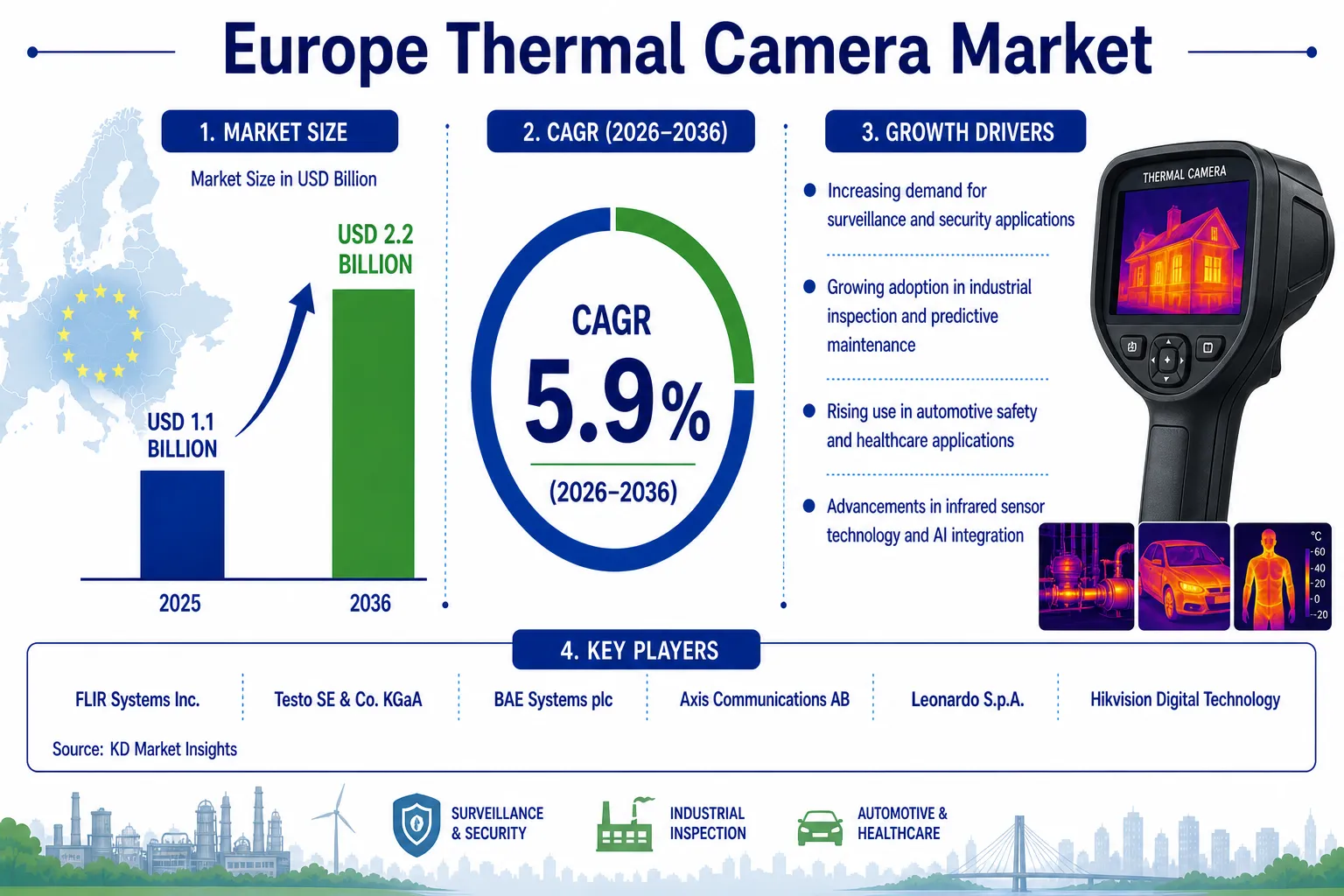
Europe thermal camera market revenue to generate USD 2.2 billion by 2036, according to KDMI analyst’s growth analysis. The market is segmented by product, solution, application, end user, and country.
Key Highlights
- 2025 Market Size: USD 1.1 Billion
- 2036 Forecast Market Size: USD 2.2 billion
- CAGR (2026–2036): 5.9%
- Largest Market: Germany
- Fastest Growing Region: United Kingdom
- Key Market Drivers: Security demand, energy efficiency regulations, industrial automation, defense spending
- Market Structure: Moderately fragmented with strong global tech & defense players
- Key Players: FLIR Systems, Raytheon Technologies, Teledyne Technologies, L3Harris Technologies, Seek Thermal, Hikvision, Bosch Security Systems, Testo SE & Co. KGaA.
What is the Europe Thermal Camera Market Size?
As per the survey report on Europe thermal camera market, the market is expected to foresee a CAGR value of 5.9% during 2026-2036, and further generate a market size of USD 2.2 billion by the end of 2036. In 2025, the market size was value at USD 1.1 billion revenue.
- The Europe thermal camera market’s growth is driven by expansion of industrial automation.
- KDMI analyst’s growth analysis foresees regulatory and privacy concerns as restraint for Europe thermal camera market.
Europe Thermal Camera Market Analysis
A thermal camera is a device that detects infrared radiations and converts it into a visible image, allowing users to "see" temperature differences in real-time. They are different from normal cameras, they do not require light, making them ideal for identifying hot spots in electronics, insulation gaps in buildings, or people in complete darkness. The Europe thermal camera market growth is driven by increasing demand, technological advancements, and expanding industrial applications. The integration of artificial intelligence and machine learning into thermal imaging systems is enhancing their capabilities, leading to more accurate and efficient results. The market is further accelerated by increasing adoption in automotive driver assistance systems (ADAS) and obstacle detection technologies. Rising road safety concerns, with more than 1.3 million fatalities reported globally, has intensified the demand for enhanced solutions under adverse weather conditions . This indirectly results in adoption of thermal imaging solutions.
|
Europe Thermal Camera Market: Report Scope |
|
|
Base Year |
2025 |
|
Estimated Market Size |
USD 1.1 billion in 2025 |
|
Forecast Year |
2025-2035 |
|
Projected Market Size |
USD 2.2 billion in 2036 |
|
CAGR Value |
5.9% |
|
Europe thermal camera Market Key Trends/ Growth Drivers |
|
|
Restraint Factors
|
|
|
Europe thermal camera Market Segmentation |
|
|
Europe thermal camera Market Key Players |
|
Europe Thermal Camera Market Growth Drivers and Restraints
Growth Drivers
- Rising defense, security, and surveillance demand – According to the data reports, total military expenditure across Europe has reached USD 864 billion in 2025, accounting for an increase of 14 per cent. Across Europe, escalating geopolitical tensions, cross-border security challenges, and the need for continuous situational awareness are significantly boosting demand for thermal cameras in defense and public safety applications. Governments are allocating higher budgets toward modernization of military and surveillance infrastructure, where thermal imaging plays a critical role in night vision, target detection, border monitoring, and reconnaissance missions. Thermal cameras are particularly valued for their ability to operate effectively in low-light and adverse weather conditions such as fog, smoke, and rain. The growing frequency of search-and-rescue operations and disaster response activities further highlights the importance of thermal imaging systems, making them indispensable for real-time detection of humans and objects, thereby driving sustained market growth.
- Expansion of industrial automation and predictive maintenance - The significant push toward Industry 4.0 and smart manufacturing across major European economies such as Germany, France, and United Kingdom is accelerating the integration of thermal cameras into industrial operations. Manufacturers are increasingly adopting thermal imaging for predictive maintenance, enabling early detection of heat anomalies in electrical systems, motors, pipelines, and mechanical equipment before failures occur. This helps reduce unplanned downtime, maintenance costs, and safety risks, ultimately improving operational efficiency and productivity. Thermal cameras are also widely used in quality control processes, ensuring consistency in production lines by identifying temperature variations in materials and components. Additionally, with rising emphasis on energy efficiency and regulatory compliance, industries are deploying thermal imaging for building inspections and energy audits to detect heat loss and optimize resource utilization. As automation and digital monitoring systems continue to evolve, the role of thermal cameras as a non-invasive, real-time diagnostic tool is becoming increasingly critical, further driving their adoption across industrial sectors.
Restraints
- Regulatory and privacy concerns – Stringent regulations regarding surveillance, data protection, and privacy concerns across European countries can limit deployment of thermal cameras, especially in public areas. EU imposing stricter regulations for safety and data protection laws increases operational complexity for manufacturers as well as end users, thereby slowing overall market adoption.
- Technical complexities – The significant restraints across Europe is that thermal cameras or imaging systems require specialized knowledge and skill to operate, integrate, and perform data interpretations. This can limit or acts as a barrier for new entrants, thereby limiting market growth.
Europe Thermal Camera Market Segmentation
Our experts at KD Market have segmented the Europe thermal camera market research report as:
|
By Type |
|
|
By Mobility |
|
|
By Application |
|
|
By end user |
|
|
By country |
|
Analyst’s Observation on Europe Thermal Camera Market Recent Developments
Over the years, the experts at KD Market Insights have been observing the recent developments associated with Europe thermal camera market trends. Our expert’s market forecast analysis has recorded the market players adopting plentiful of key strategies including new product launches, mergers & acquisitions, and collaborations.
French firm Exosens has secured its largest drone imaging order to date, supplying several thousand ultra-compact thermal camera cores to a European autonomous air defense developer. These cameras will be integrated into interceptor drones for counter-drone operations, enabling real-time detection, tracking, and engagement of aerial targets.
Hanwha Vision introduces its next-generation QVGA AI thermal surveillance camera range. The company features AI object detection, advanced thermal imaging with noise equivalent temperature difference (NETD) of less than 20mK, long-range lens options up to 60mm, and eight or 30 frames per second (fps), these high-performance cameras transform perimeter and critical infrastructure monitoring.
Europe Thermal Camera Market Competitive Landscape
Some of the significant participants who top the Europe Thermal Camera market growth:
- FLIR Systems, Inc.
- Axis Communications AB
- Testo SE & Co. KGaA
- Opgal Optronic Industries Ltd.
- Seek Thermal, Inc.
- BAE Systems
- Elbit Systems
- Raytheon Company
- MicroEpsilon
- Xenics
- Thermal Imaging Services (UK) Ltd.
- Ti Thermal Imaging LTD.
- Pixel Thermographics
- Honeywell International, Inc.
- Lockheed Martin Corporation
- Thermoteknix Systems

Need Customized Report for Your Business ?
Utilize the Power of Customized Research Aligned with Your Business Goals
Request for Customized Report- Quick Contact -
- ISO Certified Logo -



Frequently Asked Questions(FAQ)
Europe Thermal Camera Market
-: Our Clients :-