Europe Proactive Security Market
Europe Proactive Security Market Size, Trends, Opportunity, and Forecast Analysis, 2026-2036
Europe proactive security market revenue to generate USD 137.1 billion by 2036, according to KDMI analyst’s growth analysis. The market is segmented by deployment mode, component, security function, and end user.
Europe Proactive Security Market Size
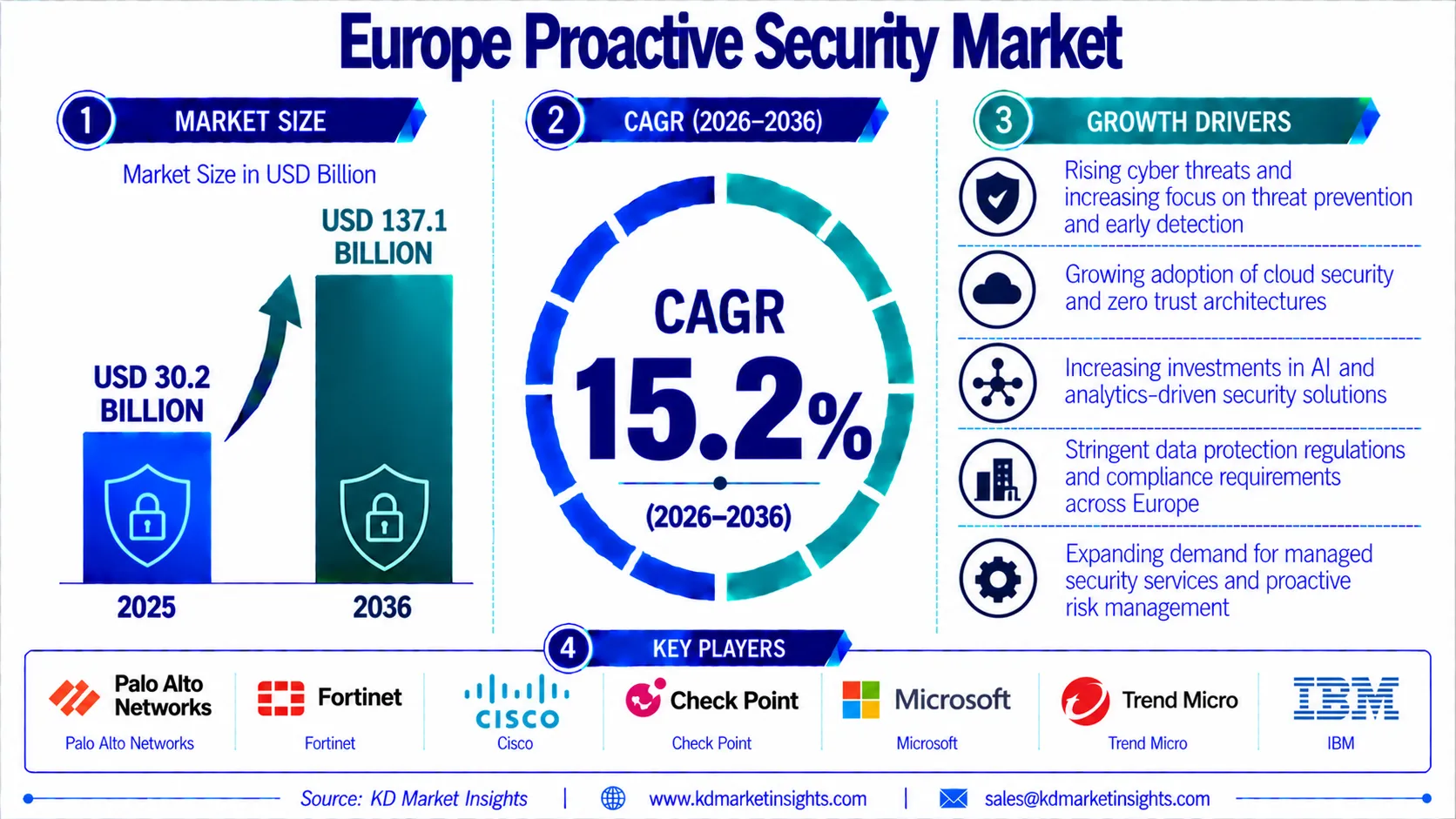
As per the survey report on Europe proactive security market, the market is expected to foresee a CAGR value of 15.2% during 2026-2036, and further generate a market size of USD 137.1 billion by the end of 2036. In 2025, the market size was value at USD 30.2 billion revenue.
- The Europe proactive security market’s growth is driven by increasing adoption of cloud computing services.
- KDMI analyst’s growth analysis foresees shortage of skilled workers as restraint for Europe proactive security market.
- In the Europe proactive security market, security function segment is playing significant role.
Europe Proactive Security Market Analysis
Proactive security is a prevention-focused approach that anticipates, identifies, and neutralizes threats before they can infiltrate systems. These systems don’s wait for a breach or incident to occur, it relies on continuous monitoring and pre-emptive hardening to significantly minimize your attack surface and financial risk. The European proactive security market growth is driven by rising cyber risks across industries. The cyber risks are growing due to rapid adoption of AI-powered platforms that are enhancing threat anticipation capabilities. According to a report by Universidad de Navarra, the EU experienced around 10,000 cyberattacks. Between July 2023 and June 2024, the most frequent type of frequent threats were Denial of Service (DoS), Distributed Denial of Service (DDoS), and Ransomware Denial of Service (RDoS). The group accounted for 41.1% of the total cyberattacks, with over 4,000 incidents. Therefore, by increasing investment in proactive security tools will help organizations to combat cyber risks, thereby driving overall market growth.
|
Europe Proactive Security Market: Report Scope |
|
|
Base Year |
2025 |
|
Estimated Market Size |
USD 30.2 Billion in 2025 |
|
Forecast Year |
2026-2036 |
|
Projected Market Size |
USD 137.1 Billion in 2036 |
|
CAGR Value |
15.2% |
|
Europe proactive security Market Key Trends/ Growth Drivers |
|
|
Restraint Factors
|
|
|
Europe proactive security Market Segmentation |
|
|
Europe proactive security Market Key Players |
|
Europe Proactive Security Market Growth Drivers and Restraints
Growth Drivers
- Growing adoption of cloud computing and digital transformation – The rapid adoption of digital transformation across Europe is significantly driving demand for proactive security solutions. Organizations across Industries such as baking, healthcare, manufacturing, retail, and government are increasingly adopting cloud computing, remote work environments, IoT devices, and digital business platforms to enhance operational efficiency and customer engagement. According to the ECIPE report, approximately 65% of surveyed companies use paid cloud services for more than 20% of their workloads. In total, over 43% of EU enterprises have brought cloud computing services in 2023. Additionally, Sweden holds the highest adoption rates for cloud computing across the European Union. Therefore, the growing reliance on cloud-based applications and hybrid IT environments is further accelerating the need for advanced security solutions, thereby supporting proactive security market.
- Increasing integration of AI and threat intelligence solutions – The integration of artificial intelligence (AI), machine learning, and advanced threat intelligence platforms is a key growth driver for the Europe proactive security market. According to EIB latest survey report, 37% of the EU businesses use generative AI to enhance operational efficiency. Also, the EIB Group has signed 89 billion euros investment in new financing for over 900 high-impact projects in 2024, with the aim to boost Europe’s competitiveness and security. As cyber threats become more sophisticated and difficult to detect through traditional methods, European enterprises are increasing adopting AI-driven proactive security tools to improve threat detection accuracy, reduce response times, and enhance overall cybersecurity resilience.
Restraints
- Shortage of skilled cybersecurity professionals – The key restraints is the shortage of qualified cybersecurity professionals, which impacts growth of market. Effective implementation of proactive security tools requires expertise to ensure efficiency and performance of tools. This skills limitation reduces overall effectiveness of security programs and slow technology adoption.
- High implementation and maintenance costs – The deployment of proactive security solutions often demands higher upfront investments in advanced threat detection platforms, security analytics tools, threat intelligence services, and continuous monitoring infrastructure. Therefore, the financial burden over cost-sensitive organization, which slowdowns market expansion.
Europe Proactive Security Market Segmentation
Our experts at KD Market Insights have segmented the Europe market research report as:
|
By component |
|
|
By security function |
|
|
By deployment mode |
|
|
By end user |
|
Europe Proactive Security Market Competitive Landscape
Some of the significant participants who top the Europe proactive security market growth:
- IBM
- Cisco Systems
- Palo Alto Networks
- Fortinet
- CrowdStrike
- Splunk
- Check Point Software Technologies
- Rapid7
- Trend Micro
- FireEye

Need Customized Report for Your Business ?
Utilize the Power of Customized Research Aligned with Your Business Goals
Request for Customized Report- Quick Contact -
- ISO Certified Logo -



Frequently Asked Questions(FAQ)
Europe Proactive Security Market
-: Our Clients :-