Brazil Biomass Gasification Market
Brazil Biomass Gasification Market Size, Trends, Opportunity, and Forecast Analysis, 2026-2036
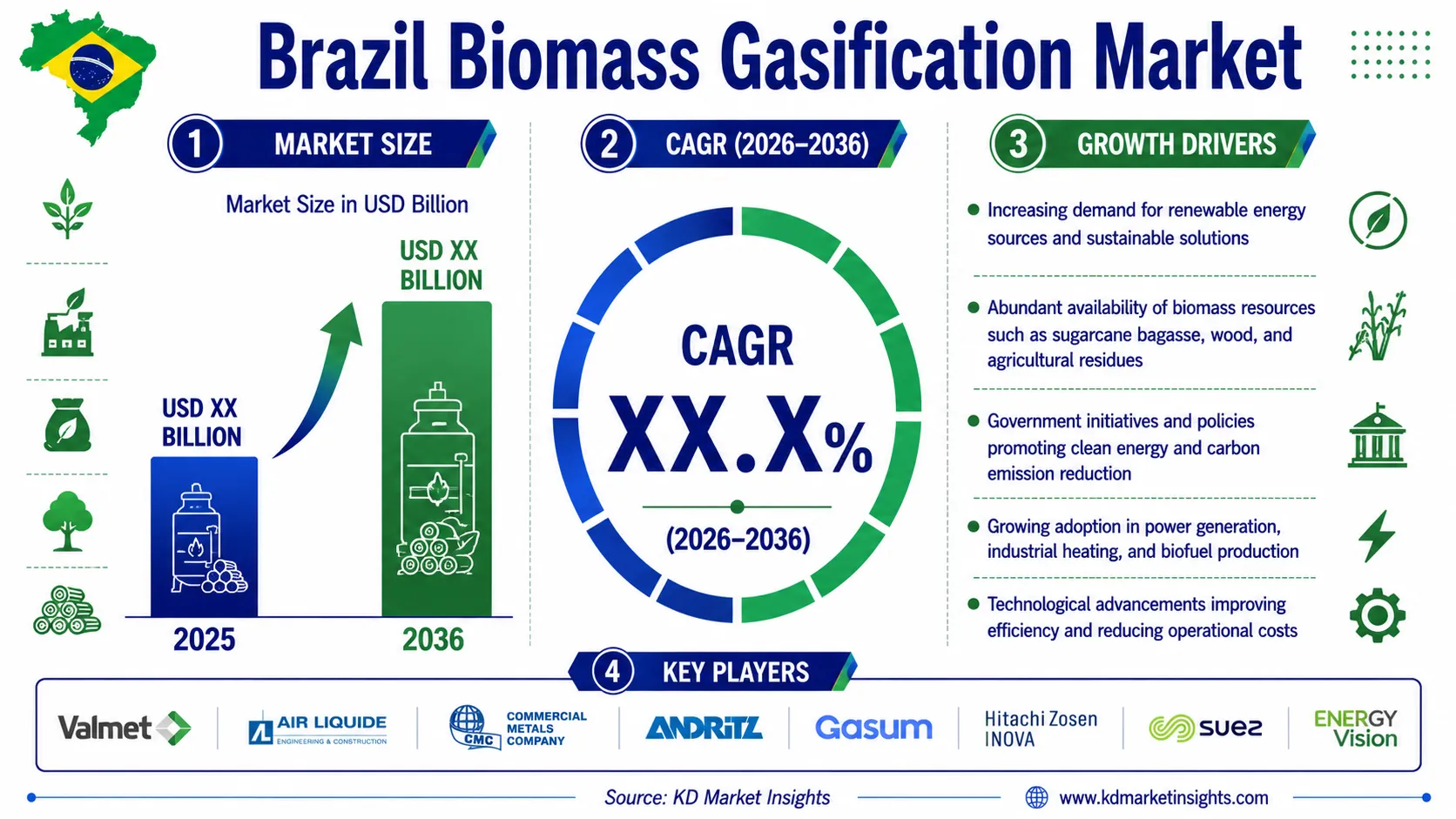
Brazil biomass gasification market revenue to generate USD XX billion by 2036, according to KDMI analyst’s growth analysis. The market is segmented by application, source, and technology.
Key Highlights
- 2025 Market Size: USD XX billion
- 2036 Forecast Market Size: USD XX billion
- CAGR (2026–2036): XX%
- Largest Segment: Fixed-bed biomass gasification systems
- Fastest Growing: Fluidized-bed biomass gasification systems
- Key Market Drivers: Renewable energy policies, biomass availability, waste-to-energy projects, industrial decarbonization, biofuel production
- Key Players: Valmet Oyj, ANDRITZ AG, EQTEC plc, Siemens Energy AG, thyssenkrupp Uhde GmbH, Air Liquide S.A., SUEZ Group, Mitsubishi Heavy Industries, Ltd., Ankur Scientific Energy Technologies Pvt. Ltd., Thermax Limited.
What is the Brazil Biomass Gasification Market Size?
As per the survey report on Brazil biomass gasification market, the market is expected to foresee a CAGR value of XX% during 2026-2036, and further generate a market size of USD XX billion by the end of 2036. In 2025, the market size was value at USD XX billion revenue.
- The Brazil biomass gasification market’s growth is driven by supportive regulatory framework.
- KDMI analyst’s growth analysis foresees high costs as restraint for Brazil biomass gasification market.
- In the Brazil biomass gasification market, source segment is playing significant role.
Brazil Biomass Gasification Market Analysis
Biomass gasification is a thermochemical process that converts organic materials, like wood chips, agricultural residues, and organic waste into a combustible gas mixture called syngas. It achieves this by heating the biomass at high temperatures in an environment with strictly limited oxygen, preventing actual combustion. The Brazil’s market growth is driven by continuous innovation and growing concern for dependency on fossil fuels and carbon emissions. According to renewables now, the total renewables share in the energy mix in Brazil rose to 49.1% in 2023. Sugarcane biomass accounted for 16.9% in renewables energy share. Furthermore, declining capital costs for gasification infrastructure, supported by public subsidies, tax credits, and feed-in tariff mechanisms, are accelerating adoption of technology in smaller utilities and industrial operators.
|
Brazil Biomass Gasification Market: Report Scope |
|
|
Base Year |
2025 |
|
Estimated Market Size |
USD XX billion in 2025 |
|
Forecast Year |
2026-2036 |
|
Projected Market Size |
USD XX billion in 2036 |
|
CAGR Value |
XX% |
|
Brazil biomass gasification Market Key Trends/ Growth Drivers |
|
|
Restraint Factors
|
|
|
Brazil biomass gasification Market Segmentation |
|
|
Brazil biomass gasification Market Key Players |
|
Brazil Biomass Gasification Market Growth Drivers and Restraints
Growth Drivers
- Supportive regulatory framework - Brazil's supportive regulatory environment is playing a significant role in driving the growth of the biomass gasification market. The government has introduced policies and incentives aimed at promoting renewable energy generation, reducing greenhouse gas emissions, and diversifying the country's energy matrix. According to International Center for Sustainable Carbon, biomass energy generation reached average of 3,218 megawatts (MW) in 2023, constituted for 4.6% of total energy consumption. In the same year, the installed biomass capacity increased to 223 MW, while output was expected to increase by 1,155 MW in 2024. In addition, favorable regulations related to renewable energy projects, tax incentives, and financing support for clean energy investments are encouraging industries and energy producers to adopt biomass gasification systems. Further, the country’s commitment to meet climate goals is creating strong demand for biomass gasification.
- Rising Agricultural Residue Utilization - The increasing utilization of agricultural residues is a major growth driver for the Brazil biomass gasification market. As one of the world's largest agricultural producers, Brazil generates substantial volumes of biomass waste from crops such as sugarcane, corn, soybeans, rice, and coffee. According to NIH data, agribusiness plays important role in the production, processing, and transformation of food. The increase in crop of agriculture production is expected to reach 60% in 2050 to meet the growing food demand. This increased activity in modern agricultural sector produces nearly 291.1 million tons of residues in its largest crop. Further, growing awareness of circular economy practices, waste-to-energy solutions, and sustainable resource management is encouraging the use of agricultural residues as feedstock for gasification plants, thereby supporting market expansion while reducing environmental impacts associated with agricultural waste disposal.
Restraints
- High initial capital investment – One of the key restraints is the high costs required for deployment of biomass gasification systems. Requirements of upfront investments for equipment, plant construction, and system integration is further creating challenges for its adoption. SMEs often face difficulties in securing capital, which limits market expansion.
- Feedstock supply chain and logistics challenges – Brazil has capacity to generate abundant agricultural and forestry residues. Its collection, transportation, storage, and processing of biomass feedstock is a complex and costlier process. Also, seasonal variations pose as a barrier for market expansion.
Brazil Biomass Gasification Market Segmentation
Our experts at KD Market Insights have segmented the Brazil biomass gasification market research report as:
|
By source |
|
|
By technology |
|
|
By application |
|
Analyst’s Observation on Brazil Biomass Gasification Market Recent Developments
Over the years, the experts at KD Market Insights have been observing the recent developments associated with Brazil biomass gasification market trends. Our expert’s market forecast analysis has recorded the market players adopting plentiful of key strategies including new product launches, mergers & acquisitions, and collaborations.
On May 12, Greenlane Renewables has entered into a partnership with Panasonic do Brasil to establish local manufacturing of its next-generation Cascade LF landfill gas upgrading technology in Brazil. Under the arrangement, Panasonic will produce Greenlane-branded modules at its facilities in São José dos Campos, São Paulo state.
On March 5, Syzygy Plasmonics has signed a memorandum of understanding with biogas developer Geo bio gas&carbon to develop commercial-scale sustainable aviation fuel (SAF) projects using biogas derived from sugarcane waste in Brazil. The companies plan to combine Geo’s experience in operating biogas assets with Syzygy’s electrified GHG e-Reforming technology, which uses light-driven chemical reactors to convert biogas into fuel products.
Brazil Biomass Gasification Market Competitive Landscape
Some of the significant participants who top the Brazil biomass gasification market growth:
- Enviva Holdings
- Drax Group
- Green Plains Inc
- Pinnacle Renewable Energy
- RWE AG
- Vattenfall AB
- Fortum Oyj
- Biomass Energy Ltd
- Yosemite Clean Energy
- SYNCRAFT
- ReGaWatt GmbH
- SynTech Bioenergy LLC

Need Customized Report for Your Business ?
Utilize the Power of Customized Research Aligned with Your Business Goals
Request for Customized Report- Quick Contact -
- ISO Certified Logo -



Frequently Asked Questions(FAQ)
Brazil Biomass Gasification Market
-: Our Clients :-